Showing posts sorted by date for query supplements. Sort by relevance Show all posts

Monday, November 14, 2011

Anxiety and Parkinson's Disease

We Don't Know Why but Anxiety Is a PD symptom
Frankly, at this time, I'm not so concerned with the why but rather the effect of anxiety on Steve's Parkinson's disease progression.  While anxiety is not unexpected when one receives a diagnosis, from what I've read, it is a more common symptom in PD than in say Diabetes, Rheumatoid Arthritis and Multiple Sclerosis. As a matter of fact it is a PD precursor symptom, often accompanied by pessimism. I always thought that Steve was over-thinking things and expressing them in a negative way; now I realize that this was a PD potential rearing its head when he was still a young man.

What we do know is that embarrassment is a risk factor for anxiety and social fears. We know that there might be an association with levodopa although probably not the other PD meds.  We know that there may be an association with norepinephrine (dopamine is the norepinephrine precursor so you can't have one without the other) and we know that there are several other neural pathways which might contribute. We've got our eye on Serotonin and GABA.  

Here's the thing, we know that anxiety was behind Steve's first bout of dehydration even though the underlying issue was actually Benign Prostatic Hyperplasia (BPH) or enlarged prostate. This in turn exacerbated feelings of urinary incontinence which in its own turn triggered extreme  anxiety - enough to stop all fluid intake except for a morning cup of coffee and enough water to swallow pills and supplements. We focused on the dehydration, how to rehydrate and how to get him back on his feet to think and to function on his own again.  We treated the cause and he started taking a common (and risky) prostate medication which he had turned down a several years earlier when he and his doctor discussed his prostate issue and actually checked for and ruled out prostate cancer.  But we never looked at the other issue - the anxiety which overrode all else.

The treatments for PD anxiety at this time are problematic.  Antidepressants of various classes: Tricyclics, SSRIs, Anti-psychotics, Benzodiazepines, and non-selective MAOIs.  In early 2010 we just weren't ready to risk the motor symptom treatment for the anxiety/non-motor symptom.

So what happened in the late summer and early fall with the second round of dehydration?  The second time around was easier to spot and know what to do. I was prepared already with electrolyte beverages - mostly fruit flavored. We kept the drinks flowing. He prefers ice water from the pitcher.  We had the adult incontinence briefs on hand to relieve the issue of weakened ability to get to the bathroom on time and to get through the night. Although there was no question of doing the right things for recovery, each time there seems to be a larger cognitive deficit.

We recently made some other nutritional supplement changes and I adjusted up and down to determine if they constituted any part of the problem. All the time, the vivid dreams, the hallucinations and illusions increased making Steve's reality very confusing; contributing to the a high anxiety level.

We finally resorted to using an herbal to help with the anxiety after I realized that he was self-medicating with aspirin and found an empty bottle - which had been almost full a week before. I read everything I could find about the herbal components because it does help relieve the anxiety on a short term basis. The best I can say is that it seems to have the fewest contraindicated ingredients.  Certainly a better option now than prescription medications. 

In addition to retreating to the safety of his bedroom for frequent naps - mostly because he feels anxious, one significant new issue was freezing. We are still working through this problem. Steve now has his key words to help him through the tight spots but it took 3 months and he intermittently lets panic rule so that he mixes up the words in the commands:  Look Up and Walk Forward. Mostly they had a calming effect and then anxiety takes over and the words become other words - the wrong commands.  

I can now see that fear in his shuffle step. It makes me wonder how many shufflers out there are just plain scared.  I hadn't seen it in those movements for many months but now I recognize the enemy. It isn't just postural instability - a precursor or early symptom of his - it is his terror that something bad will happen on the next step.

I know he has recovered just enough arm swing with the new form of buffered creatine monohydrate that he can walk at a slow pace but with a normal balanced stride, shifting his weight from side to side, using his shoulders to propel himself forward (that's Walk Forward)  He has to be reminded in the early morning, when he wakes from a nap and in the evening but sometimes he can let himself relax enough to walk without anxiety. That makes my heart sing.

Watch those stairs
Our next project will be stairs.  He's gone downstairs only a few times since the dehydration but he had few problems going down and none on the way back up.  But he is afraid. He sees a black hole and not the steps leading to the 1st floor. He is anxious every time he walks past the stairway. His sister, a nurse, mentioned that perhaps it is eyesight issues which help trigger the fear and we'll check that possibility. 

We're looking for solutions to the anxiety, the cognition losses, and the PD psychosis which play a large part in making his world a more frightening place. One possible solution may lie in a clinical trial taking place in our neck of the woods.  We provided a link to the Fox Trial Finder in the right column under Clinical Trials but how serendipitous to have a reminder email from PAN (Parkinson's Action Network) this morning. I used that link, and looked at trials in our area again and found some new ones.  So we sent an email to the Pimavanserin Trial, heard back promptly with a phone number and are waiting to hear back from the Cleveland Clinic Study Coordinator. We are hoping that if the psychosis can be treated, we can work more effectively to lessen the anxiety.

Addendum 3/12:
On 3/06/12 The Parkinson's Disease Foundation presented an Expert Briefing, A Closer Look at Anxiety and Depression in Parkinson's Disease led by Dr Laura Marsh. The archived webinar/podcast is now available at PDF.  Listen rapidly as Dr Marsh covered a lot of material in a short period of time. I plan to listen again.

Friday, August 5, 2011

The Effects of Added Stress in Parkinson's Disease

Does Stress Exacerbate PD Symptoms?
Dehydration Brought on by Stress

Things have been a bit hectic around here for the last several weeks. Hectic means that Steve will be become stressed no matter how things are handled.  And stress means that there is little predictability about how he will react. Here it meant that Steve was growing steadily more anxious about the impending appearance of the roofing crew. Strangers were going to be all over his roof doing work which he could no longer supervise let alone climb the ladders to monitor. To top it off family dogs were spending their parents' vacation with us.

Having a father-daughter chat
The Corgis didn't come to Ohio this summer to brighten the days with their grins and antics but our daughter was able to spend some quality time with Steve. After Lois left for Georgia, the English Setters arrived while their mom and dad traveled to New England to repair plumbing and visit aging AD parents .

For me the roofing job was stressful in terms of $$$$$ spent and the not-so-hot clean-up which followed but it was a relief to have the roof leak-free. It should outlast us. For Steve it was the stress of unknown people, sun-up to sunset noise, and chaos that sent him around the corner to a darker place.

We know that stress means that the PD patient will become more symptomatic. Tremors appear more frequently. If Steve is severely stressed, his entire body might shake. As soon as he calms down, that shaking will stop as abruptly as it began. But it is the psychological symptoms which really affect his physical state. When feeling stressed, one symptom is that he manifests is feeling that he has to urinate more often - not unusual - but in the case of many men, it means that he is going to lower his fluid intake to avoid accidents. His body also becomes more rigid and he walks with a tiny shuffle severely impacting his balance.

In this hot summer with fans but no central air conditioning, the sweat level has also been high. And that feeling of heat fatigue is not conducive to drinking more water to compensate but rather to begin the shut down.  Dehydration looks a lot like the end stages of Parkinson's.

Although I caught the dehydration symptoms early and tried to monitor the water consumption, he pulled a water bottle bait and switch on me and it was a few days before I realized that he was showing me the older empty bottles. And then...the bottom fell out.

Let's face it, caregivers are often pushed to their limits by their charges. Whether you are a spouse, sibling or child, there comes a time when the fear and the urgency of the situation (feels as if it) forces us from gentle into harpy mode. He complains that he is dying and you find yourself in the body of a screaming bitch who is yelling, Do you want to live? Then stop trying to kill yourself. Help me help you!  There is no question that the fear-factor forced him to give this some thought by the next morning and he was more open to suggestion but still quite demanding..

Even though Steve never cared about really cold drinks, ice water has helped more than anything else. It isn't a lot of ice water at one time but rather, smaller amounts frequently...we topped off everything with a few sips through the straw. (Yes, I know he doesn't like straws but they are helping)  I mixed his creatine (which must be first dissolved in very warm water) with ice cold blueberry/pomegranate juice. And he now downs it promptly. We use 2 or 3 trays of ice cubes a day just on his ice water. Too much water can also be damaging to the system - more is not always better just as less is always not more.

Instead of going through weeks and weeks of a debilitating condition as he did in the winter of 2009-2010, he is coming back steadily from that horrible place. He can walk down the hall without help; although the cane is useful with four dogs around. He can get into bed on his own again. Am I going to let him select his medications and supplements from the organizer?  Not for awhile yet - perhaps not again.

Eventually we will report on adult underwear and other incontinence aids we have used. Some are clearly more absorbent than others. For now, the fever is gone, the total confusion is ending, he is neither helpless nor totally rigid in the morning, unable to get out of bed. Yes, he needs encouragement to gently stretch before sitting up. At least now he can do that.

He has been miserable as he saw everything seem to vanish over night. Cognition, movement, bladder control, ability to dress, to function. He couldn't even use the TV remote a few days ago; now he's back to switching programs I am listening to in midstream.  He walks down the hall easily pushing aside the rawhide dog chews and gently tapping with his care to ask a resting canine to move clear of his path.  He has even become more careful with his special PD prisim lenses because he is back online and can't see the monitor without these glasses.

Topper watching roofers
Willson sleeps comfortably
Despite Steve's fussing, I firmly believe having the Setters visit was a help for both of us, not to mention Harry and Rita. The silky Setters make for delightful and calming petting in the temporary absence of the cats.  While Blakey comes upstairs to complain from time to time, he has chosen to spend most of his time in the much cooler dehumidified basement with Mongo who does not like any dogs but his own.
 
Next year we may add a dehumidifier for the 2nd floor. And next week I'll lay in a better supply of drinks to compensate for electrolyte loss.  We're going to add cocomut water and Gatorade to the pantry.

Friday, June 17, 2011

Random Thoughts and Ideas about Parkinson's Disease

PD is always with us even when we ignore it

An apology is in order for the dearth of posts lately. We've been tweaking past posts and side column information and now we'd like to share some random thoughts we've had recently.


Lifestyle aids - If you look hard enough you'll find several interesting products including scissors. At one point in our household there were two lefties. One had to have a lefty scissors, the other couldn't use one. But this is different. There is a long reach scissors for helping with toenails. We don't know if it is really long enough but it might help. There is also a table top mounted scissors which might help for those who can only use one hand.


We wrote about other basic assistive devices a few years ago. It's always a good idea to keep checking because people are always finding clever ways to help adapt to PD issues. We would appreciate your input on experience with adult incontinence underwear brands through your comments below or by email.


Toe Cramps? If a calcium/magnesium along with a potassium supplement doesn't work, perhaps Gel Flex Toe Stretchers or YogaPro Yoga Toes might help. They look sort of like the foam pads I tried to use for separating my toes to keep nail polish from smearing. Would those work too? Those will cost about $2.00 for a pair.

The laser mobility walker for Parkinson's disease. Made by U-step who also makes a laser cane, these walkers are not inexpensive although you can still get considerable support form Medicare for their purchase. This is a heavy duty walker with seat and basket, the laser device which helps to break a freeze can be purchased separately.

We've only mentioned medical alert tags once, but the more we read anecdotal experiences, the more we realize just how important these dog tags, pendants, wallet cards, bracelets can be. It is important that the information be on the tag itself. There are several companies which can create this identification for you. Consider how symptomatic you might become or how painful withdrawal might be if medical personnel did not have your medication information upon admission to the hospital...or even before that.

Multi-tasking. In ADHD low levels of dopamine prevent a child from focusing - is that similar to the lowered ability of PwPs to multi-task?

Saw this little guy down the street
We were delighted to see him
No imagination required
Hallucinations vs imagination How do we distinguish between seeing faces and animals in the cloud shapes and hallucinating that we are Seeing Faces in clouds, carpets and patterns when dopamine levels are elevated? "Life isn't about waiting for the storm to pass. It's about learning to dance in the rain." "Will you, won't you, will you, won't you, will you join the dance?" And if not the dance, will you walk or march with me?

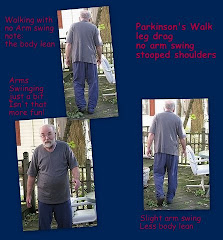
Walking and arm swing - did you know that it takes more energy to walk with your arms still than to swing them? Arm swing helps to counterbalance the body - keeping your hips from twisting too much. It has been learned that if you walk with the leading leg and the arm swing on the same side of the body (think Pacer in horse racing) it actually requires 25% more energy than a normal walk with leading leg and opposing arm swing. So where is it in the brain? As evidenced by DBS surgery and possibly PD levodopa treatment, upper arm locomotor synergies are influenced by the basal ganglia.

Steve has been taking a different form of Creatine for the last few weeks and has regained a small amount of arm swing on that PD side. Although we switch brands of supplements from time to time, we're going to be sticking with CreaSol, a flavored powder which is mixed with warm water. It is the micronized form of creatine monohydrate which is also available at about 1/2 the price, although a bit tricker to dissolve.


Ayruvedic medicine promotes walking as an activity which will bring the various energies of the body into balance. Walking is low impact and considered to be a healthy activity for all body types. We're glad to report that Steve has started taking walks again. This means that he has been reporting back on the garage sales and who is setting up a wedding tent in the back yard. Walking can be very valuable.


We know that the rhythm of the dance apparently helps people with PD move in ways their condition suggests they can no longer move. How do You walk to music? We know that music is an anxiotic -an anti-anxiety aid. We know that music can actually have analgesic properties. It can decrease heart rate, respiration rate, and blood pressure. Music has been used for therapy since early times. Rhythm is just one aspect which seems to be very helpful in PD. If you don't want to get out of that chair, listen to the music.

So what about melatonin, the nighttime hormone produced by the pineal gland? Is it just another push-me-pull-you of PD? Exposure to sunlight suppresses melatonin production. Melatonin release then inhibits the release of dopamine in specific areas of the central nervous system (hypothalamus, hippocampus, medulla-pons, and retina). It is possible that this in turn plays a role in the causation of PD since inhibition of dopamine will have consequences on bodily movements. Although the antioxidant effect of melatonin may offer neuroprotection for mitochondrial activity, the inhibition of dopamine release is not a goal of PwPs.


CoQ10 and Parkinson's disease. OK, CoQ10 trials have come to a halt. Co-enzyme Quercetin 10 does not slow the progression of PD. Steve found that it definitely made him feel better in the early years of his PD. He found that it did help with tremor easing. Did he think it was slowing progression? He felt that it was helping with symptomatic relief. And that in itself is significant. We need larger studies in the improvement of PD visual function because another small study had positive results.  Moreover, two studies for cardiac patients had positive results. In one CFS study, patients who took CoQ10 demonstrated a serious reduction in congestive heart failure symptoms and had required fewer hospitalizations. One heart transplant patient study had only minimally positive results while a shorter, smaller study had some positive results.

Steve and Rita on a walk in the park
Rhinorrhea or Rhinitis is increased in PD. Who would think that a runny nose would be symptomatic of PD but according to Dr Joseph H Friedman, that is exactly the case. They have not determined whether it is related to olfactory deficits as well but it is not only a symptoms but it can be a precursor symptom as well. I've noticed the increased need for throat clearing due to post nasal drip with Steve. Once he's done that, it is much easier to understand him when he speaks. Rhinorrhea in Parkinson's disease by Dr Joseph H Friedman, MD Rhinorrhea: a common nondopaminergic feature of Parkinson's disease.

Seborrhoeic dermatitis - autonomic symptom - immunodeficiency - aloe vera or coconut oil - crude diluted honey - avocado extracts and supplements such as lactobacillus, B vitamins: B7 (biotin), B6, B2, B3. Alternative treatment= apply milk of magnesia to face or scalp when showering (rinse off at end of shower)

Autonomic Neuropathy a form of peripheral neuropathy, is found in symptoms which occur when there is damage to the nerves which regulate blood pressure, heart rate, bowel and bladder emptying, digestion and impotence. So that helps to explain the Pd symptoms: constipation, urinary incontinence, urinary hesitancy, incomplete emptying of bladder and yes, RLS. It also helps to explain postural instability or dizziness upon standing or sitting up, hyperhidrosis (excessive sweating, difficulty swallowing.

In Parkinson's disease concerns are very real. Falling, weight loss leading to malnutrition, dehydration and electrolyte imbalance, choking. although rarely mentioned there is also a risk of kidney failure caused by urine back up accompanying incomplete emptying of bladder.


Steve loves marigolds
Which leads us to the symptoms of kidney problems which can lead to kidney failure if untreated. Headaches, aches and pains. Feeling tired all of the time. Loss of appetite. Bone and joint issues, itching and restless leg feeling. One problem is that a lower backache can be the only symptom and is associated more with stiffening muscles that with a kidney infection. It might be ignored. Anemia can develop because the red blood cell count is low. Low red blood cell count = low oxygen levels for cells. Insomnia/daytime sleepiness. The basic problem is that UTIs are common in latter stages of PD when organs begin to shut down and when catheters have become necessary. It is important for caregivers to be on the lookout for the signs.

Exercise aids - we've talked about the portable assisted pedaler in a previous post. We'll add the findings of other PD users as the reports come in. If you can  find a therapy center or club which has forced exercise on its program, join it! 

Voice Exercises - in the comfort of your own home, you can take Mary Spremulli's Voice Aerobics class on DVD. She also as Songbirds in an audio CD and offers The Breather to aid in breathing in and exhaling. Mary is a medical speech-language pathologist who has many years of experience in her field. Visit her website to learn more, you won't regret it.

On 9-18-11 we were sent a link for a pocket sized breathing exerciser:

Respiratory Muscle Strength Trainer, a simple hand-held device looking very much like a large whistle. Regular use should help improve the strength of the muscles used to inhale and exhale. Most everyone remembers having a whistle as a child. This devise might appeal to the aging but young at heart and demonstrate important therapeutic results.

Saturday, April 2, 2011

Early Warning Signs of Parkinson's Disease

Precursor Symptoms of PD - What's the Tipoff? And What Were Your Earliest PD Symptoms?
In retrospect; in hindsight; if only I'd known; I wish I'd looked for more answers; why didn't the doctor say something?  I should have...done something more... 
If the precursor symptoms are recognized as Parkinson's disease, can early intervention at least delay the onset? 
Earliest warning symptoms of Parkinson's usually go ignored or are attributed to some other condition. There isn't a single symptom you or your loved one can have that is unique to PD, although as a group some are more unique. There are diagnostics which can rule out some many differential diagnoses even at this early date.
The biggest impediment to addressing the developing Parkinson's disease after the early warning signs or precursor symptoms appear is that we do not recognize them for what they are. We don't even know what they are.
  • Leg drag
  • Lack of Arm Swing
  • Loss of Sense of Smell - decreased sense of smell - phantom smells
  • Changes in Handwriting
  • Changes in Voice
  • Change in Facial Expression
  • Pain or achiness in the Shoulder or Neck, more common in women
  • Depression, anxiety, stress
  • Sleep problems - especially with especially with REM sleep or more specifically RBD sleep. Sleep issues may also include "acting out" during sleep: Yelling, kicking, punching. 
  • Signs of specific Vitamin Deficiencies: Ds and Bs especially
  • Sharp small pains - pinprick pains - or perhaps small areas of numbness
  • An odd type of vertigo - which may actually be Orthostatic Hypotension which is known to develop years before the actual PD diagnosis
  • Dizziness
  • Adding additional symptoms beginning 4-05-11 with THANKS to the folks at Patients Like Me
  • Urinary issues such as urinary incontinence or frequency
  • Impairment of color discrimination - may improve with levodopa
  • Fatigue - tiring more easily at routine tasks - lack of stamina - daytime sleepiness
  • Cramping
  • Rhinorrhea - that's a runny nose to most of us
  • Seborrhoeic dermatitis -  an autononic symptom, an immunodeficiency - flaking is often confused with dry skin - possibly seen as dandruff
  • numbness - usually in extremities
  • We would like to learn if people experienced any of the following as precursor - earliest - symptoms
  • Sleep apnea ?
  • Constipation
  • RLS - restless leg syndrome?
  • Excessive sweating - an autonomic nervous system dysfunction?
  • Personality changes or changes in Executive functioning
  • Hyperhydrosis or excessive sweating which can sometimes appear as Seborrhoeic dermatitis - might feel like hot flashes
  • Erectile Dysfunction
  • Vision issues such as difficulty focusing
    I'd also like to add:  Unexplained tripping or falling which I overlooked

In an era when there is access to symptoms of every conceivable disease at our fingertips, there is little information about PD precursor symptoms on the Internet. If you do a web search, you won't find much about them.  I just did that and mostly what I found were articles I'd already written.  
Think back to the months and even years before your diagnosis, what do you recall of the precursor symptoms?  We're talking about those symptoms which you attributed to being tired, to stress or anxiety, to physical exertion, to anything but PD because that wasn't even a consideration. 
So you are X-rayed, MRI'd, you have endocrine tests, thyroid tests, blood tests and a few more for good measure and that's good because it makes sense with these early symptoms. But PD doesn't show up on these kinds of tests currently. And then what happens?
The doctor rules out a condition or two and then gives you the verdict: "Well, you don't have X*X?."  And that's it. You pay your bill, you go home, your spouse asks what the doctor said and you say, "Well I don't have X*X?."   Many of us have been trained to accept this kind of negative diagnosis, but that's wrong.  We can all do better. 
As families and patients we have a right to expect some positive action.  And doctors should certainly know this. That message needs to be sent from the patient base if it isn't taught in medical schools.  As patients we have a responsibility too.  We have to overcome the relief that we don't have X*X? and the fear of what comes next and we have to ask, "What comes next?"
The very early warning signs are now being recognized as an significant area of study but the symptom list is not ready for prime time yet. The communication from the research front will be forthcoming when the studies have been completed. The good news is that studies are now underway.
These studies represent a way in which people with PD can contribute.  Even if we can't improve the future for ourselves, we can use what we have learned to improve the precious future of someone else, perhaps our children or grandchildren.
Listed at Clinical Trials.gov are three studies of especial interest:
  1. Investigate neurophysiologic tests that have the potential of serving as screening tools- New Haven, CT
Another source of information is found in the notes in patient files tucked away in doctors' offices. This is the information that needs to be shared at seminars, in articles.  There would be no HIPAA violation, names would not be named but the symptoms could be compiled.  Yes, it is a huge undertaking but it would make a remarkably useful study.

Our best body of knowledge now comes from proactive patients who share their stories.  Not all are sucess stories but they demonstrate the importance of a the current studies and the importance of a productive doctor-patient relationship. Many thanks to those enerous folks on Patients Like Me who added to the list of early warning symptoms.

It is far more important for both the medical profession and the general public to raise their awareness of early warning symptoms of neurodegenerative diseases, especially Parkinson’s disease, because treatment can begin earlier. Now that there are more treatment and therapy options, it makes sense to try to slow onset.

What we are wondering is whether the immediate treatments will lie more in Alternative Medicine in the form of Nutritional Supplements rather than in pharmacological medications.  What will be the role of therapies such as Forced Exercise?
Previous posts on subject:
Questions about Parkinson's Disease

You might also be willing to contribute to the knowledge base by registering to participate in an NIH study:
Study Link for Biomarkers of Risk of Parkinson's Disease at the National Institutes of Health. 
Check our this discussion of the Top Ten non-motor symptoms of Parkinson's disease from Dopadoc.

Monday, January 31, 2011

Parkinson's Updates, Odds, Ends, Beginnings

PD Community Info Including Neupro Updates

If you missed the PD Expert Briefing on Physical Therapy and Parkinson's, What You Need to Know, you may have a second chance to watch, listen and to ask questions. Heather J Cianci, PT, Geriatric Clinical specialist, MS, trained in Lee Silverman Voice Therapy will be presenting the program again following a technical glitch.

We did attend the first broadcast - minus the slides - and although there wasn't a lot that we haven't written about on this blog, we still learned a few things.  Parkinson's Disease Foundation (PDF) has announced that the rebroadcast will take place on Tuesday, February 8, 2011 at 1:00 EST

We have questions about the use of Low Dose Naltrexone (LDN) by people with Parkinson's and are hoping that people who who have or are currently using LDN will provide some feedback about the experiences. There is an LDN Worldwide DataBase that would also like to have your input. There is quite a bit of information submitted by Multiple Sclerosis (MS) patients, but very little on PD. Just select Parkinson's from the left hand buttons. We have also posted links in the LDN articles.

Currently there is a study funded by a grant from the Michael J Fox Foundation, NCT01052831 Dr David Weintraub of the University of Pennsylvania in Philadelphia is studying the safety and use of LDN for impulse control disorders in PD. This study is still enrolling and Dr Weintraub reports that there is some limited travel money available.

Because LDN already has FDA approval for one use, it is not economically feasible for a pharmaceutical company to fund one for the use of LDN and Parkinson's disease. For this reason much of the information is going to be anecdotal. That is why adding honest information at a website or database is important. To add a comment at this website, there is always the option to remain anonymous.

We’ve also read the responses to LDN discussion at Patients Like Me and we are encouraged enough to make this a priority for the next neurology appointment.

We just came across LDN Science and think you might want to check this site for LDN information.  

There is hope for getting Neupro now
I'm sorry for the delay update about the Neupro (rotigotine) Transdermal Patch. I am pleased to report that although there is no program called "compassionate use" for people who were already using the patch prior to the withdrawal from the market and who have not been able to locate suppliers in other countries, there is an opportunity for people who have been on the patch and potential new users to receive it through the Named Patient Program, clinical trial.

We are providing a link to NCT0195484 which is a Named Patient Program with Rotigotine Transdermal System by invitation only study. The locations for the study are in Alabama, Arizona, California, Washington DC, Florida, Georgia, Hawaii, Illinois, Michigan, New Jersey, New York, North Carolina, Oregon, Texas and Washington.

We now have the contact email address and phone numbers so that your doctor can contact UCB to be sent the request for study enrollment form. The form would then be completed and mailed or faxed to UCB for consideration.  A patient must be under a doctor's care for consideration. I suggest speaking with your prescribing doctor. We will be provide you with all of the contact info (email, phone, fax) at UCB by email if needed.  Just click the email link.

OMG! We just found another Neupro Clinical Trial for PwPs in the USA who wanted to start the Neupro (rotigotine) Transdermal Patch only to find that it had been withdrawn from the market. There are strict inclusion and exclusion criteria but if the patient meets these, there is a possibility that you will be provided with the real patch.  We don't know if there is an open label trial at the end or not but we will try to learn more.  The trial is NCT00522379 and is of course sponsored by UCB, Inc.  Check it out if you or a family member might benefit from this Neupro clinical trial.

Time may be running out to contribute to the funding supporting the making of Ride with Larry, a documentary about the cross-state ride of a retired police captain in South Dakota who bikes to work every day despite or perhaps because he has had Parkinson’s disease for about 20 years. Although they've made their goal, they can still use your help. You can see a trailer of the documentary and donate at the site below.

Laughter is good medicine
Paypal donations for the documentary can still be made at the documentary.org website. Just click the Make a Donation box. This is a 501(c)(3) organization.

People often ask what is the best medicine for Parkinson's disease and I must say that there is no best answer, what is best is what works to relieve your symptoms and will allow you to have the best quality of life possible. For most people, one medication, one treatment is not going to be enough. We still encourage everyone explore dietary adjustments; nutritional supplements of good quality; physical (exercise), speech, massage, occupational, music and dance therapy. Never forget the power of true laughter to feel better.

Wednesday, June 9, 2010

Changing Stages of Parkinson's Disease

I'm Back

This is the first  article I have written for my blog in almost six months.  After eight years of  having Parkinson's disease and treating it fairly successfully with medication, alternative medication and nutritional supplements, exercise, massage and diet changes, I ran into trouble between Thanksgiving and Xmas last year.  I thought they were symptoms of  PD.

The urinary symptoms which had been under control were no longer controllable; perhaps because I was neglecting to take the herbals which had helped for so long. Suddenly I had to urinate really frequently and didn't always make it to the bathroom even though my bed is only 20 feet away. I became afraid to leave home for fear of being too far from a rest room. Vivid dreams occurred so often that I could not tell what was real and what was not. My overall memory of this period is vague but I felt as if I were dying.

Although I primarily stayed in bed, often I thought I was someplace else and worried about how I was going to get home. In an amazingly short period of time I went from the early stages of Parkinson's to an advanced state; it seemed to take 2 or 3 weeks. (Editor's comment: it was practically overnight)

How did I get to that state?

In early November I had an appointment with my primary care doctor to discuss some alternative treatment options.  He referred me to the neurologist to continue this discussion. The urinary issues were not discussed although we did discuss my arthritic knee and the loose tendons. One area of concern for me was the MRI he proposed.  I do not like MRIs. I do not like being in places which I cannot leave of my own free will. 

Even the open MRI which I was supposed to have done years ago, did not take place because it was too stressful for me. This doctor  suggested that we could begin with an Xray and take it from there.  He gave me the lab order but I was too shaken by the mere mention of an MRI to do even that.

We made the neurology appointment as suggested and then my wife decided that the Xrays had to be done before that appointment in three weeks.  She finally nagged me to the lab for the Xrays a few days before I was to see the neuro.  That weekend I hardly slept and the urinary issues were getting worse. I wasn't eating as much and had been limiting my coffee and tea intake because of the urinary frequency and urinary hesitancy. As a matter of fact, I was limiting all fluid intake.  No fluid - no urinary frequency - no problem. But there was a problem and the frequency urges did not stop.

By the time we were talking to the neurologist, the transition was taking place. I asked not for the intended alternative treatment but for Sinemet which I thought would help the urinary issues.  He agreed after the routine PD testing.  By the next day the nightmare was developing full force.

Almost overnight I was having difficulty walking down the hall. I could barely stand erect. Cognitive skills were muddled by hallucinations and illusions.  I needed assistance to get into bed, instructions just to roll over. I needed help pulling up the blanket. Dressing and bathing without help was impossible. I would get up to eat but continued to drink only enough liquid to swallow a pill.  I recognized the woman who prodded me about drinking more water during the day as being very similar in appearance to the woman who responded to my nightly hollering for help. Who was she?  This nurse gave me my wife's name when I asked.  What was this place?

My wife, meanwhile, was learning what you need to do to get a doctor's secretary to relay the seriousness of a condition. Because I had signed a release allowing the office to speak to my wife about my care, she knew she was on safe ground there. Her early calls were partially successful.  The primary care office called back to refer her to the neurologist. The neurologist called back to say that Parkinson's disease can't go through such a short term transition and so we were looking for another cause possibly a UTI...and referred her back to the primary care doc.

She made the appointment for the following Monday and sat down to think and to discuss the issue with the massage therapist when she called to cancel my appointment. Sleep deprivation was only part of the problem.  So she gave me cranberry capsules insisting that I drink more water.  For half a day, I had a return to normalcy.  And she had an insight.  I was dehydrated

When we went to the doctor's appointment, she took my urine specimen along.  She insisted that it be tested.  When it came back negative the discussion turned to prostate issues.  We left with sample bottles of Flomax.  What we didn't know was how long it would take before the Flomax would work - that it actually would be another 5 weeks before for the compulsive insistence that she walk me to the bathroom every 20 minutes would stop.

The dehydration issue was caused by the enlarged prostate which I knew about but didn't discuss much. Years earlier I didn't want to take the meds and had found relief with herbals. But this time I had confused the prostate problem with PD which exhibits the same symptoms.  I'm an older man, older men frequently develop prostate issues.  Had I talked to my new doctor about the problems instead of accepting that they were part of the disease, I wouldn't have had to endure all of this.  The damage done by the dehydration, the stress for all of us except the cats - the dogs were very subdued during the first month - was intense.

It has been a long recovery and we learned a few lessons and revisited a few others.

 1)  Protective underwear is cheap in comparison to losing 4 productive months.
 2)  Sign that doctor's release now so that your spouse or other family member can talk to the doctors office
 3)  Don't make that call or visit the doctor without a complete written list - make copies
 4)  Symptoms of dehydration and sleep deprivation are similar to dementia and to PDD
 5)  Ask how long it will be before you can expect to feel results from a medication
 6)  If a nutritional supplement helps, don't stop taking it just because there are so many pills to take
 7)  Don't assume that the problem is caused by the Big Problem;there can also be other medical issues - tell your doctor. 
 8)  Just because a doctor prescribes it, that doesn't mean you shouldn't do your own research for contraindications. (I have a faxed-in prescription that we will never fill for just that reason - my wife did the homework)
 9)  All of you caregivers out there deserve more credit than you receive! 
10) Be persistent - it can be depressing - don't give up.    

Monday, January 25, 2010

Titration and Parkinson's Disease Medications

Withdrawal happens - it is not punishment for taking bad drugs
Loosely related ramblings
There are several types of medication which require a low, steady buildup to the necessary effective dosage. You doctor advises you, the pamphlet you get from the pharmacy will tell you and so will the online sites for that drug. Sometimes in our hurry to switch from one medication to another, it is easy to forget that if you go up slowly, you need to titrate down in a similar manner in order for your body to adjust. And that even if you don't, your body has built up if not a dependence, at least a familiarity with the medication that requires recognition.

While titration downward may cause some symptomatic issues, in the long run your body will thank you. There can be some serious conditions resulting from an abrupt withdrawal. Titrating down from any medication you are discontinuing may be a general rule of thumb until more research is conducted. But there is sufficient research on many meds.

A few weeks one of Steve's doctor prescribed a medication with which I was not familiar. Actually I didn't understand the name he said on the phone and figured I'd just look it up once I had the bottle in hand. (Let that be a lesson to me about being intimidated by an impatient doctor.)

Once home from the pharmacy I began the online search and discovered that this medication could not be taken within 14 days of having an MAOI in the system. So this was not the medication for Steve because he was not giving up the Azilect (an MAO-B inhibitor) which he has been taking since soon after it hit the US market. Although this is a new doctor for Steve, I had provided him with a written list of all meds and regular supplements as well as all symptoms and current issues but he just missed this call. It is important to do your own homework.

A longer time ago than I care to realize, we switched our son from a pediatric to an adult medicine doctor because the peds doc and I weren't in sync. We disagreed too often for either of us to be comfortable. And the worst thing is that I was right far too often. I cite the last incident as an example.

It turned out that a sad prior experience shared with me by our beloved Veterinarian over a distemper puppy from the pound. What we learned about pediatric medicine taught us both about how rapidly respiratory issues can turn on you.

In this case I felt that a sudden temperature shift had turned on my son and I wanted his meds switched immediately. The peds doc disagreed. So off we went to Xray. Brought the pictures back to the nurse and we waited and waited in the room designated for such things while the doc read the Xrays and wrote a new prescription because that was what the Xrays told him was needed. Being right didn't help because the peds doc acknowledged it in a surprising way. He left an anxious mother cooling her heals while a very sick child lay on the bench struggling to breathe and with a rising temp for a very long time. Ostensibly the doc was studying and considering while we waited for him to tell us what he had seen and what could be done.

Instead of meeting with us personally, he actually left the building for lunch. He'd told me off earlier so rather than face me, he made tracks. Finally I ventured through that closed door through which one is not supposed to travel unless invited, found the nurse and was handed the new prescription with no other explanation. And our son, of course, got better.

There are a few points to that story. Be proactive - Don't sit and wait. You or your family member are your only patient, the doctor has plenty. Only you can get things moving. Don't just sit there.

But the story doesn't stopped there. I moved our son to adult medicine and shortly thereafter took him in as a followup. He came out with a prescription for prednisone.

Anyway here was this young boy who had been prescribed a heavy-duty medication and a few weeks later I realized that the bottle was still fairly full - too full. I asked him about it when he returned from school. He said the doctor had told him that he had to ease his way up - take the medication - and ease his way down. So he had titrated up, didn't like the way the steroid made him feel and promptly titrated his way back down.

Just so you know, why didn't I know about what the doc had told him...because at the first appointment this favorite human doctor had gently closed the door in my face saying, "Mom, this isn't Peds - this is adult medicine and you aren't invited." Although I never regretted that move as it served our son well, it did teach me many years later, that when its PD, I want to be in the room. (And to make sure that Steve has signed the necessary release for me to discuss issues with his doctors.)

So that was how I learned about titration. From our pre-teen son.

Ken in England, who sends us links of interest, recently sent us one about DAWS.  Dopamine Agonist Withdrawal Syndrome.

Steve reports that when he discontinued the Mirapex, he told his doctor that he was going to titrate down and his doctor told him how to do it. He reports that you should be able to tell if you are titrating down too rapidly; that if you are cutting back to fast your body should respond. Steve was discontinuing Mirapex (a dopamine agonist) and Selegiline (an MAO-B inhibitor) because he had problems with impulse control disorders (ICDs) and hallucinations as serious side effects of the medications. In Steve's case he was not taking levodopa because that was not his first drug of choice and the Mirapex and Selegiline were working well in controlling symptoms.

Reducing dosage of Parkinson's drugs can cause symptoms similar to those of cocaine withdrawal was a study by Dr Melissa Nirenberg and Christina Rabinak at New York-Presbyterian Hospital- Weill Cornell Medical center NY, NY.  What is interesting about this study is that it not only focused only on the ICDs, such as shopping, gambling, eating, hyper-sexuality or sexual behaviors, but also focused on levodopa with the implication that there could be an addictive relationship because of the reward implication of the mesocorticolimbic pathways.

The withdrawal symptoms can be diarrhea, dizziness, anxiety, irritability, agitation, chills. Withdrawal symptoms usually abate but they can be confused with other medical or psychiatric causes.

Dopamine Agonists are not the only meds to watch if discontinuing. SSRIs, Selective Serotonin Re-uptake Inhibitors used as antidepressants to treat depression can do exactly the same thing. And, because they can induce more profound detrimental side effects in a Parkinson's patient, are often discontinued. Caution must be taken when titrating down. You should read more about Discontinuation Syndrome is you plan to discontinue your SSRI.

PwPs may have other medical conditions being treated concurrently. It is important to be aware of all interactions so that adverse affects can be monitored and discontinuation done properly.

There is actually a serious life-threatening condition known as Neuroleptic Malignant Syndrome which can result at both the onset of adding a new drug or the abrupt cessation of certain prescription medications. Making proper titration up and down all the more important.

Withdrawal symptoms are not punishment for people who do illegal drugs, they can happen to anyone.

Additional reading:
A good explanation for the study can be found in another study. Dopamine agonists influence learning and striatal reward prediction errors in PD patients with compulsive disorders

Friday, December 11, 2009

Treatments for Parkinson's Disease

Parkinson's disease is treated in several ways. And treatment is what is currently available; there are no sure-fire cures. Sadly, treatments often lose their effectiveness to combat both the symptoms and the progression of the disease as the years pass.

To confound the problem of treatment is the fact that Parkinson's disease is a collection of syndromes with varied symptoms and progression rates.  Treatment needs to be adjusted to the individual.

Knowledgeable physicians and proactive PD patients learn to be aware of when adjustments in dosage, timing, the addition of another medication to work with the current prescribed med can be effective in prolonging "on" times and reducing "off" times. And some are aware that nutritional supplements are as much a part of a therapeutic regimen as the prescription pad.  Other physical therapies are acknowledged by advanced medical plans so that all you need is a prescription for a sessions which the patient can often continue.

So what are the options?  Let's begin with a summary of prescribed medications by category.  We'd love to post the handy-dandy medication chart we made listing product names, generic names, symptoms for use, contraindications, side effects and some general information about the way the medication works but, doggone it, we've been unable to transfer the table successfully to the blog-site.  We're working on it.  Today we're working from the printed version.  

Prescription Medication:

DOPAMINERGICS are the most common  - these have been the "gold standard" for many years but are not without problems and may not be the best choice for the newly diagnosed.

The standard treatment has been Sinemet (levodopa-carbidopa) This is still the first line treatment for the majority of patients but is losing some ground to Azilect

Levodopa is absorbed into the blood stream in the small intestine and converted into dopamine after in crosses the blood brain barrier. (note: dopamine cannot cross the blood brain barrier)
Problem:  Levodopa has a short half-life and a major side effect is nausea which can last up to a year. A number of other problems can occur including hallucinations common to other PD meds.

The combination of levodopa-carbidopa improves the functioning of the levodopa, prolongs the "wearing off" meaning fewer side effects such as the dyskinesia-dystonia. It can also allow for a lower levodopa dosage.

Other dopaminergics include Madopar which is levodopa-benserazide hcl.
Carbidopa is also a dopaminergic - it inhibits the peripheral metabolism of levodopa prior to crossing the BBB.
For people who have trouble swallowing there is Parcopa (levodopa-carbidopa) which is orally dissolvable.

The most common immediate unpleasant side effect of dopaminergics is nausea which can last for up to a year but may be relieved by increasing the carbidopa. Timing is  important and taking with a low-protein meal may reduce nausea.  It is suggested that a regular protein meal follow Sinemet by at least one hour.

DOPAMINE AGONISTS - bind to different dopamine receptors - they are sometimes taken with antagonists because they have a short half life. The binding activates the dopamine receptor pathways.
I'm not going to list all but the most common include bromocriptine, Requip XL (ropinirole), Mirapex, Trivastal, and the Neupro Transdermal patch (rotigotine) returned to the European market last June and is anticipated to return to the US market in July 2012 - although it is not entirely unavailable to US prescription holders.

DOPAMINE ANTAGONISTS are primarily used as anti-psychotics. They bind but they don't stimulate dopamine receptors - they copy the effect of DA.

COMT INHIBITORS - inhibit the catechol-menthyltransferase enzyme to inhibit the break-down of dopamine after its release in the brain. They begin to work immediately after the first dose. They are often combined with levodopa-carbidopa later in treatment. Common names include Comtan (entacapone) Tasmar (tolcapone and Stalevo (which is a combination of levodopa-carbidopa-entacapone)

MAOI-Bs are another category - Monoamine oxidase-B inhibitors or MAO-B inhibitors slow the breakdown of dopamine by inhibiting MAO-B enzyme. By this action, the dosage of levodopa-carbidopa may also be reduced.
Common MAOI-Bs include Selegiline or Eldepryl, Zelpar. These still carry the tyramine-cheese effect warning which is actually more common to MAO-As. There is also EMSAM which is a transdermal patch of Selegiline which is also approved by the FDA for treatment of Major Depressive Disorder. The 6 mg EMSAM patch does not carry a tyramine warning..

Another MAO-B which differs chemically from Selegiline is Azilect. Many people are turning to Azilect as a first line medication - before any other anti-parkinson's meds because it has shown to be very effective in slowing the progression of this disease. Currently there are trials to determine its effectiveness in being later combined with levodopa-carbidopa to reduce the "Off" times and to prolong the effective usage of levodopa/carbidopa. On December 14, 2009 FDA approved the removal of the tyramine warning from the Azilect label.

OTHER MEDS include off-label meds which have been effective for some people.
They include: Amantadine, an anti-viral which increases the release of dopamine.
DynaCirc CR - a calcium channel blocker or calcium agonist - which tries to restore the cells to a more youthful saline condition.
Note: it is thought that dopamine is forced into the cytoplasm prematurely and there it combines with misfolded alpha synuclein and calcium to create the gummy mess which causes the dopamine to die.
The Exelon patch - a reversible chlorinesterase inhibitor used for moderate dementia, cognitive skills loss and executive skills.
Aricept functions in a similar way but is still more common to Alzheimer's patients.

In the next category are the ANTICHLORINERGICS which block acetylcholine to compensate for that loss of homeostasis with the declining dopamine neurons. They are not as commonly used now but are the oldest of the modern PD meds.
A few names are Artane, Cogentin, Norflex, Benadryl.

I'm not going to list the ANTI-DEPRESSANTS and the various categories such as SSRIs but that is another category of PD meds and yes, we have another fussy table that won't transfer properly.  But we will post it one day because it is helpful.

Okay, what's next? Many people would love to be able to use NUTRITIONAL SUPPLEMENTS or alternatives to conventional medication and there are a number of  important supplements,  but make no mistake, they too have side effects and can have an impact upon brain/body homeostasis - often the reason for use - unless contraindicated or mis-used.

Most of these nutritional supplements can be found in foods but to get the right amounts to fight free radicals we supplement.  To get the optimal amounts of some nutritional supplements, we take capsules and tablets, powders and liquids.  Often we could not possibly eat enough of a particular food and/or those food may also include other elements which in larger amounts might not be so beneficial. Remember also that for PwPs smaller capsules seem to work best unless you can find a chewable or better yet a sublingual that doesn't result in a burning sensation.

In this category are Antioxidants such as CoQ10. Another very important antioxidant for PD is glutathione in either sublingual, liquid or the expensive IV treatment. We'll be writing more on glutathione and N-Acetyl L-Cysteine. Vitamins C and E are antioxidants which work synergistically, even more so with the addition of Alpha Lipoic Acid.  Vitamin A is well stored in the body but an occasional boost might not hurt either as beta carotene or as Vitamin A.

PwPs have deficiencies of certain B vitamins. A low dose of B complex (25-50 mgs max) might be in order. Otherwise B2, B5, B6 and B12 can be adjusted separately.

D3 will help to boost the immune system and for PD patients who don't get out into the sunlight much - there is no other alternative to producing Vitamin D in the body.  Other supplements to consider are: Acetyl L-Carnitine which is sometimes found in combination with Alpha Lipoic Acid.

Creatine is not just for weightlifters and body builders, PwPs are taking it also.  Not just any creatine, however but micronized creatine monohydrate which is available as a pharmaceutical grade product. Creatine is also a powerful antioxidant for scavenging ROS.

You don't hear much discussion about mushroom extracts for PD immune system enhancers but  Maitake, Reishi, Shitake and Astragalus can sometimes be found in a combination capsule (to keep the cost down).

For folks with digestive issues, consider ginger or Lactobaculis Acidophilus for a healthier GI tract balance.  This is very important when diarrhea is an issue or after a course of antibiotics which also does a number on the friendly flora in the gut.

Omega 3 oil is another nutritional supplement.  Another interesting source of essential fatty acids (EFAs) for PD is Coconut Oil, a medium chain triglyceride.  It has an unique combination of fatty acids and does come in capsule form if you don't find one with a decent taste for food preparation.

If you're not drinking green tea, there's a capsule for that and might actually be better for providing what you need without what you do't need. And if you don't cook with a good turmeric from India, it also comes in pills as well.  The primary ingredient of turmeric is a powerful anti-inflammatory in the form of curcuminoids.  Recent research (2012) indicates that the curcuminoids in turmeric are effective in preventing the clumping of alpha synuclein proteinsMoreover, it may do this by speeding up the folding and reconfiguration of alpha synuclein. 

We don't have any experience with mucuna pruriens. You can obtain mucuna pruriens as velvet or fava beans.  It is also available in as seeds, powder, capsule or extract.  The problem is finding the "dose" that works for you since much of it will be lost in the digestive process.  Standardized doses may work more effectively and be safer.  You can find it online as Dopabean from at least one company.  Be wary of claims about the L-dopa content because many companies products are not standardized, making it very difficult to determine how much you need and to risk getting too much or too little.
9/2011 Addendum: Steve has some experience with mucuna pruriens now and we will be writing about it when he has used it for a longer period of time and we know more about the assistive benefits of EGCg found in green tea..

HEALTHY DIET for PD:includes items listed above as well as below.

You're going to have to make the adjustments to your medication schedule and the type and restrictions of those meds.  For nutritional suggestions, some diets like the Mediterranean diet may be a bit healthier and use some very helpful seasonings.  The focus here is on olive oil which actually enables utilization of  nutrients from fruits and veggetables, fish rather than too much red meat, and red wine (in moderation). 
don't forget the green and black tea or a few black walnuts a day.

MASSAGE THERAPY
Is invaluable on a regular basis. This is more than our opinion it has been clinically demonstrated.  If you have the $$$$ and can afford it, 2 sessions a week would be ideal. One session would be good and less than that will see many reversals of the good done. Medical massage - Swedish Massage involves the entire body with focus on the problem areas and issues and really should be done by the same licensed therapist all of the time. Massage increases endorphin levels, works to break up muscle knots, reduces stiffness and alleviates pain caused by a variety of conditions.  An important element in treating postural instability, massage should be on your therapy wish list.  Unfortunately this valuable therapy is not recognized by most health insurers including Medicare.  Other forms of useful massage include Shiatsu/acupressure, and Neutomuscular Therapy (NMT).  Massage therapy can also be beneficial as behavioral therpay when treating anxiety and depression found in PwPs...and their caregivers.

PHYSICAL THERAPY

Occupational therapy for assistance with tasks of daily living. Getting into bed, standing and sitting, buttoning a shirt, whatever. While this is not permanent on-going therapy, a patient will need refresher courses as the disease progresses. Care-givers should attend these sessions if permitted.

Exercise therapy can include a wide variety of therapies: swim, dance, yoga, tai chi,  nautilus equipment, exercise bikes - especially motorized bikes for legs and arms, vocal exercises.

Forced Exercise: is a more recent concept but very exciting. If it you find access to the right equipment and can put in the required time, it might work for to reduce reliance on higher dosages of medication and to relieve some symptoms.

Voice therapy will include the very important breathing exercises to aid speaking, breathing, swallowing. If you can't get to a therapist, there are home exercises which will help.

OTHER TREATMENTS
As the disease progresses there is also Deep Brain Stimulation if the patient meets the qualifications and the physicians feel they are good candidates.

There are older surgical procedures but are not as commonly used in this century. More treatments and surgeries are in the pipeline. However, it was announced in October, 2010 that these older surgieries are still valid and moreover can be used with DBS with the understanding that there is a higher risk of depression with subthalmic nuclei surgeries.

While we are not convinced that any form of stem cell treatment performed now will have more than limited advantage, who wouldn't want to have that advantage for a few years?  If successful, there appear to be reversals after a few years.  The various forms of cell therapy are still works in progress and are still pipeline treatments.

Although not treatments, tools that can help the PD patient with activities of daily living are part of the therapy to assist unaided or semi-aided functioning.  Special handled flatware, laser canes, shirts with snaps, cups that prevent spillage, walkers with baskets and seats, voice recognition programs and other computer programs to enable "typing", bath seats, higher toilet seats will be of use to many PwPs.

One last observation: a plan is needed that involves the dreaded "what if" stuff.  How and who and when, where and why.  Quite a bit of planning may be necessary for a disease which can render a person almost completely non-functional.  Families need to discuss these matters with the patient in the beginning. Plans must be made to make the home safe for the PwP so that they can remain there as long as possible.
 
And plans must be made to relieve caregivers from time to time. I'd suggest weekly to be realistic to their needs.  Several hours are necessary so that they can catch up with social activities, do shopping, spend some uninterrupted time with reading or email or just get a well deserved rest to make up for their own sleep deprivation. 

Think what a wonderful Holiday Present some free time would be to someone who needs recharged batteries.