I know that my wife's Grandmother ascribed to the concept that you can't be too rich or too thin
 but I'll have to take exception here to the fact that you can be too thin. For Parkinson's disease maintaining a normal weight is important to maintaining some modicum of health.
Unexpected weight loss can be an early indication of parkinson's disease or it can be symptomatic of the progression of the PWPs condition. Parkinson's patients who are thin with a low BMI (Body Mass Index) are at a significantly higher risk of dementia especially if they already have some dementia symptoms.
It is difficult for some parkinson's patients to maintain weight especially when they are taking sinemet/levadopa medications and want to confine their protein consumption later in the day. They may be avoiding tyramine containing foods (the cheese syndrome avoidance for MAOI-A) and when they can't eat some of their favorite foods, eating isn't as much fun. And late-day protein can lead to night time symptoms which can be dangerous and frightening.
At the physical therapy center where I exercise there is an accurate doctor's balance beam scale which many members use every day to keep track of their weight. Since a rapid change in weight can be a serious problem, we monitor sudden or surprise weight changes which need to be addressed with a visit to the doctor. Patients and caregivers need to report sudden weight changes to the doctor or nutritionist to work on solutions immediately because the body will use muscle for fuel before fat in an attempt to survive.
A slow loss of weight can be due to several things, the weakening/stiffening of the muscles caused by PD. When stiffness lowers a PWP's ability to swallow, proper diet may suffer. Difficulty cooking for and feeding oneself also contributes to weight loss - can't do it so why bother? Medications can change the taste of food and the fear of choking can scare them away from foods like broccoli, bread and pastas, vegetables, proteins.
In some patients, depression and apathy deaden the desire to eat. Some are embarrassed by
 how long it takes them to finish eating and stop before they are done. Some eat improperly or don't because they have lost their senses of smell and taste which diminishes the pleasure of eating. While others simply don't have the money or know-how to eat properly or cook with seasonings to make food palatable or easy to swallow. And still others have dental problems specific to PD.
Although some people exhibit weight loss before they are diagnosed, at least one study found that many people lost weight in the early and advanced stages of the disease. In a Mayo Clinic study they observed unexplained weight loss in women for a 10 year period prior to being diagnosed with Alzheimer's disease. There was speculation that it might have been a steadily growing lack of interest or possibly post-menopausal hormone changes as there was no comparable observation about men.
Not getting enough calories and proper nutrition can lead to serious problems down the PD road. As the body weakens, symptoms can progress more rapidly. In the late stages poor nutrition can lead to bedsores, dehydration and eventually PEG tube feeding. Not having the energy to get through the day is a serious issue. Symptomatically and systematically Parkinson's disease can impede the nutritional process from eating (delivery) to elimination.
So yes, Gram, you can be too thin, it's called Failure to Thrive (FTT)
 and it's found in premature infants with underdeveloped digestive systems, in the very elderly and in the chronically ill. When we lose weight unexpectedly possibly 10% of our body weight in 6 months, that's what it is: failure to thrive. And it needs to be treated.
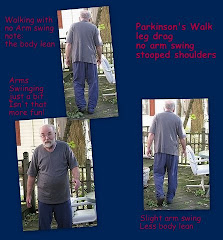
Note: the pictures of my late father-in-law were taken 4 years apart. He had a heart condition. Following cardiac arrest, he underwent bypass and pacemaker surgery but a few months later had a debilitating stroke. Following the stroke he gradually stopped eating. We miss him, we miss his presence.
We'll pick up this up tomorrow with a discussion about weight loss influences of PD medications, symptoms for caregivers to watch for, diet issues, dental problems and other specific PD issues. See you then.
references and reading:
http://www.ncbi.nlm.nih.gov/pubmed/19117356
http://www.ncbi.nlm.nih.gov/pubmed/12731005


 Posts
Posts