Showing posts with label PD shuffle. Show all posts

Thursday, October 1, 2009

Heads Up - I Have Parkinson's Disease

What Can Be Done to Correct PD Postural Instability and balance

For the past year and a half, I've been getting a Swedish massage at least 3 times a month because it reduces the arthritic pain in my knees. This is pain that keeps me from being able to walk very far - like out to the car in the parking lot, or exercise as much and as hard as I want. The massage therapist has spent hours on the stiffness and muscle knots in my shoulders. The massage allows me to avoid taking pain killers, prescription or over the counter.

Massage provides many benefits. For this person with Parkinson's disease, it reduces the rigidly and stiffness of the PD affected muscles in my left side neck and shoulder, arm and hand. When it's been a couple of weeks between massages, I have more difficulty getting in and out of the car and the shower. After the massage it is easier for me to get my legs between the rollers in the leg extension and leg curl machines at the therapy center.

The massage therapist can feel stiffness in my body that I haven't felt yet or have forgotten about. This week she was concerned about my posture, the fact that I walk or sit with my head down. Not good.

My wife has been after me about it as well. She's been making me march up and down the hall with my head up - looking down the hall at her hand held at face level. "Never mind the cats," she says, "they'll get out of the way. Just look up and ahead." My massage therapist even suggested that I could look up at the ceiling. Wow! That calls for a lot of trust in my balance.

So I took off my prism reading glasses, put on the every-place-else trifocals, set down my cane and marched up and down the hall with my head held higher. And what do you know, my wife said my stride was longer and my gait twice as fast!

This reminder isn't new to me. Back in the day when our son played hockey, at the coaches request I made a plywood barricade to hang on front of the goal cage for shooting practice. The barricade had openings at the four corners for the entry of the successful puck. I painted it black and in large white letters we printed LOOK UP as a reminder for the shooter to keep his eyes not on the puck but on the goal.

And of course the same was  true in horseback riding. Looking down sent the horse a message through my spine and seat that he was to shorten his stride. Look up, look ahead for forward impulsion.

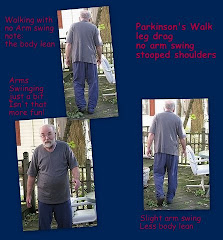
Abraham N Lieberman, MD, at the Mohamed Ali Center in Phoenix, AZ, judges morbidity by a patient's posture. Those with their heads down in their 70s will not be alive in their 90s. So I'm trying to concentrate on that. I keep having mental images of the bad posture of PWPs I have met at the physical therapy center and at the support group, several bent close to 90 degrees. I really don't want to end up like that but I don't know if I have the resolve to keep my head up enough to avoid it, even though postural instability is a quality of life or death matter for me.

I know that the concern isn't just about the appearance I present - looking more like an old man rather than the middle age man I might be - this isn't just about walking faster. Because I know that bad PD posture means I am shutting off my airways, compressing my organs, contributing to those nasty internal problems. This is about survival. I am going to not only tolerate those shouts to look up when she isn't even looking, I'm going to try to keep my head up because I want to look ahead.

Addendum: We recently read an 2007 article entitled Impaired vertical postural control and proprioceptive integration deficits in Parkinson's disease and feel that there is more to think about on the issue of balance and PD and the specialized requirements of a PwP.  We'll be posting that article on or before 2/25/2010

Wednesday, May 13, 2009

Step out with Parkinson's Disease

Walking Aids for PD
If you're a regular reader you know that Steve walks with a cane for maintaining balance and especially to support his arthritic knee(s). The cane is used in public and around the house. The cats are careful but sleeping dogs are often in the way. While the dogs don't jump up to throw him off balance, they usually remain stationary unless instructed to move. Their decision to lie still seems to be made either because they know they mustn't move suddenly or because they don't realize that they are spread across a hallway or blocking a narrow passage in our office.

Steve has no problem with gait freezing so he can use a regular cane, purchased not for beauty but for adjustability and economy. Early on when his cane use was arbitrary, he used to misplace them. He'd walk into a room with a cane but leave without it. Later the cane would be "lost." So we bought several including a folding cane for airplane use.

For those who need more balance support, there are four-footed style "quad" canes which provide that extra stability. There is a "couch/recliner" cane with a skid proof base and extra long grips to help one rise from a sitting position. A cane will support about 25% of your weight.

For those with gait freeze, there are laser canes which assist the PWP (person with Parkinson's) by shining a red laser light across the path to break the freeze and direct the next step. The canes are adjustable and battery operated. They cost between $225.00 and $275.00.

There are adjustable walkers with padded backs and seats, baskets and brakes. These have weight capacities between 250 to 400 pounds and sell for between $150.00 and $200.00 plus shipping. Walkers can support up to 50% of your weight.

The U-Step walker is exactly what you would expect, a solid walker complete with a seat for about $550.00 and up plus the add-on laser for $200.00. It has dead-man brakes which will also lock the wheels so that you can sit when necessary. The padded seat lifts to provide access to the basket. It is the laser light add-on which makes this walker unique. More expensive than a verbal cue, turning a cane upside down or a wadded piece of paper dropped as a marker, it is also practical for those with more advanced walking issues.

Currently there is an open label clinical trial NCT00320242 in Phase III sponsored by Beth Israel Deaconess Medical Center in Boston to assess the efficacy of visual cues of the laser cane or the U-Step Walker with laser accessory for PWP with gait freeze. The trials are located in Boston and at The Neurological Institute of New York at Columbia University.

There is also a Virtual Reality device available at a significantly higher price from two companies. Medigait LLC has two models for assistance. The less expensive model, the GaitAid Auditory Walker, provides a signal through the headphones depending upon foot placement. The goal is to create a ryhthmic and longer stride. The GaitAid Virtual Walker includes the auditory tones while the user wears see-thru goggles which superimpose a grid pattern on the floor. It is reported that there is a serious improvement after just two practice sessions of 30 minutes each. The figures vary but are a testament to the plasticity of the brain and the ingenuity of scientists and researchers. These goggles are meant for (re)training purposes only and are not worn on the street.

Apparently still in pre-production is the brainchild of Tom Riess, a podiatrist with PD who developed spectacles - augmented reality - which are now known as a visual cueing system. He sold the concept to HMD Therapeutics who in turn licensed it to Enhanced Visual Systems. Unlike the GaitAid Virtual Walker, these glasses appear to fit over even very large eyeglasses.

Loss of mobility is a serious problem for PWP but having aids can be a quality of life-saver.

Clinical trial:
NCT00320242 is a can't lose clinical trial since it is open label and is a comparison of efficacy of these gait freeze aids.
http://clinicaltrials.gov/ct2/show/NCT00320242
Interesting reading:
http://portal.acm.org/citation.cfm?id=1498190
How to use walkers and canes:
http://orthoinfo.aaos.org/topic.cfm?topic=A00181
Kinesia Paradoxa or gait freeze
http://www.hitl.washington.edu/publications/prothero/node13.html
Detailed information on virtual reality glasses
http://cordis.europa.eu/ictresults/index.cfm?section=news&tpl=article&BrowsingType=Features&ID=57062
Specifics on the visual cueing system and Kinesia Paradoxa in Parkinson's disease
http://www.rehab.research.va.gov/jour/07/44/3/pdf/kaminsky.pdf
You'll find a video here:
http://www.sciencedaily.com/videos/2007/1201-glasses_help_parkinsons_patients.htm