Showing posts with label Walking. Show all posts

Friday, June 17, 2011

Random Thoughts and Ideas about Parkinson's Disease

PD is always with us even when we ignore it

An apology is in order for the dearth of posts lately. We've been tweaking past posts and side column information and now we'd like to share some random thoughts we've had recently.


Lifestyle aids - If you look hard enough you'll find several interesting products including scissors. At one point in our household there were two lefties. One had to have a lefty scissors, the other couldn't use one. But this is different. There is a long reach scissors for helping with toenails. We don't know if it is really long enough but it might help. There is also a table top mounted scissors which might help for those who can only use one hand.


We wrote about other basic assistive devices a few years ago. It's always a good idea to keep checking because people are always finding clever ways to help adapt to PD issues. We would appreciate your input on experience with adult incontinence underwear brands through your comments below or by email.


Toe Cramps? If a calcium/magnesium along with a potassium supplement doesn't work, perhaps Gel Flex Toe Stretchers or YogaPro Yoga Toes might help. They look sort of like the foam pads I tried to use for separating my toes to keep nail polish from smearing. Would those work too? Those will cost about $2.00 for a pair.

The laser mobility walker for Parkinson's disease. Made by U-step who also makes a laser cane, these walkers are not inexpensive although you can still get considerable support form Medicare for their purchase. This is a heavy duty walker with seat and basket, the laser device which helps to break a freeze can be purchased separately.

We've only mentioned medical alert tags once, but the more we read anecdotal experiences, the more we realize just how important these dog tags, pendants, wallet cards, bracelets can be. It is important that the information be on the tag itself. There are several companies which can create this identification for you. Consider how symptomatic you might become or how painful withdrawal might be if medical personnel did not have your medication information upon admission to the hospital...or even before that.

Multi-tasking. In ADHD low levels of dopamine prevent a child from focusing - is that similar to the lowered ability of PwPs to multi-task?

Saw this little guy down the street
We were delighted to see him
No imagination required
Hallucinations vs imagination How do we distinguish between seeing faces and animals in the cloud shapes and hallucinating that we are Seeing Faces in clouds, carpets and patterns when dopamine levels are elevated? "Life isn't about waiting for the storm to pass. It's about learning to dance in the rain." "Will you, won't you, will you, won't you, will you join the dance?" And if not the dance, will you walk or march with me?

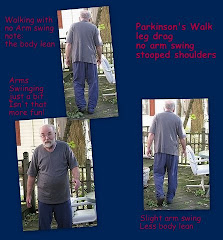
Walking and arm swing - did you know that it takes more energy to walk with your arms still than to swing them? Arm swing helps to counterbalance the body - keeping your hips from twisting too much. It has been learned that if you walk with the leading leg and the arm swing on the same side of the body (think Pacer in horse racing) it actually requires 25% more energy than a normal walk with leading leg and opposing arm swing. So where is it in the brain? As evidenced by DBS surgery and possibly PD levodopa treatment, upper arm locomotor synergies are influenced by the basal ganglia.

Steve has been taking a different form of Creatine for the last few weeks and has regained a small amount of arm swing on that PD side. Although we switch brands of supplements from time to time, we're going to be sticking with CreaSol, a flavored powder which is mixed with warm water. It is the micronized form of creatine monohydrate which is also available at about 1/2 the price, although a bit tricker to dissolve.


Ayruvedic medicine promotes walking as an activity which will bring the various energies of the body into balance. Walking is low impact and considered to be a healthy activity for all body types. We're glad to report that Steve has started taking walks again. This means that he has been reporting back on the garage sales and who is setting up a wedding tent in the back yard. Walking can be very valuable.


We know that the rhythm of the dance apparently helps people with PD move in ways their condition suggests they can no longer move. How do You walk to music? We know that music is an anxiotic -an anti-anxiety aid. We know that music can actually have analgesic properties. It can decrease heart rate, respiration rate, and blood pressure. Music has been used for therapy since early times. Rhythm is just one aspect which seems to be very helpful in PD. If you don't want to get out of that chair, listen to the music.

So what about melatonin, the nighttime hormone produced by the pineal gland? Is it just another push-me-pull-you of PD? Exposure to sunlight suppresses melatonin production. Melatonin release then inhibits the release of dopamine in specific areas of the central nervous system (hypothalamus, hippocampus, medulla-pons, and retina). It is possible that this in turn plays a role in the causation of PD since inhibition of dopamine will have consequences on bodily movements. Although the antioxidant effect of melatonin may offer neuroprotection for mitochondrial activity, the inhibition of dopamine release is not a goal of PwPs.


CoQ10 and Parkinson's disease. OK, CoQ10 trials have come to a halt. Co-enzyme Quercetin 10 does not slow the progression of PD. Steve found that it definitely made him feel better in the early years of his PD. He found that it did help with tremor easing. Did he think it was slowing progression? He felt that it was helping with symptomatic relief. And that in itself is significant. We need larger studies in the improvement of PD visual function because another small study had positive results.  Moreover, two studies for cardiac patients had positive results. In one CFS study, patients who took CoQ10 demonstrated a serious reduction in congestive heart failure symptoms and had required fewer hospitalizations. One heart transplant patient study had only minimally positive results while a shorter, smaller study had some positive results.

Steve and Rita on a walk in the park
Rhinorrhea or Rhinitis is increased in PD. Who would think that a runny nose would be symptomatic of PD but according to Dr Joseph H Friedman, that is exactly the case. They have not determined whether it is related to olfactory deficits as well but it is not only a symptoms but it can be a precursor symptom as well. I've noticed the increased need for throat clearing due to post nasal drip with Steve. Once he's done that, it is much easier to understand him when he speaks. Rhinorrhea in Parkinson's disease by Dr Joseph H Friedman, MD Rhinorrhea: a common nondopaminergic feature of Parkinson's disease.

Seborrhoeic dermatitis - autonomic symptom - immunodeficiency - aloe vera or coconut oil - crude diluted honey - avocado extracts and supplements such as lactobacillus, B vitamins: B7 (biotin), B6, B2, B3. Alternative treatment= apply milk of magnesia to face or scalp when showering (rinse off at end of shower)

Autonomic Neuropathy a form of peripheral neuropathy, is found in symptoms which occur when there is damage to the nerves which regulate blood pressure, heart rate, bowel and bladder emptying, digestion and impotence. So that helps to explain the Pd symptoms: constipation, urinary incontinence, urinary hesitancy, incomplete emptying of bladder and yes, RLS. It also helps to explain postural instability or dizziness upon standing or sitting up, hyperhidrosis (excessive sweating, difficulty swallowing.

In Parkinson's disease concerns are very real. Falling, weight loss leading to malnutrition, dehydration and electrolyte imbalance, choking. although rarely mentioned there is also a risk of kidney failure caused by urine back up accompanying incomplete emptying of bladder.


Steve loves marigolds
Which leads us to the symptoms of kidney problems which can lead to kidney failure if untreated. Headaches, aches and pains. Feeling tired all of the time. Loss of appetite. Bone and joint issues, itching and restless leg feeling. One problem is that a lower backache can be the only symptom and is associated more with stiffening muscles that with a kidney infection. It might be ignored. Anemia can develop because the red blood cell count is low. Low red blood cell count = low oxygen levels for cells. Insomnia/daytime sleepiness. The basic problem is that UTIs are common in latter stages of PD when organs begin to shut down and when catheters have become necessary. It is important for caregivers to be on the lookout for the signs.

Exercise aids - we've talked about the portable assisted pedaler in a previous post. We'll add the findings of other PD users as the reports come in. If you can  find a therapy center or club which has forced exercise on its program, join it! 

Voice Exercises - in the comfort of your own home, you can take Mary Spremulli's Voice Aerobics class on DVD. She also as Songbirds in an audio CD and offers The Breather to aid in breathing in and exhaling. Mary is a medical speech-language pathologist who has many years of experience in her field. Visit her website to learn more, you won't regret it.

On 9-18-11 we were sent a link for a pocket sized breathing exerciser:

Respiratory Muscle Strength Trainer, a simple hand-held device looking very much like a large whistle. Regular use should help improve the strength of the muscles used to inhale and exhale. Most everyone remembers having a whistle as a child. This devise might appeal to the aging but young at heart and demonstrate important therapeutic results.

Thursday, October 30, 2008

BASIC EXERCISES FOR PARKINSON'S - MY TOP 10

NAVIGATING SAFELY THROUGH THE DAY

While these may not look like the exercises that you expected, they are the basics for people with Parkinson's and other neuro-motor diseases. We cover walking, turning, balancing, sitting, rising, arm swinging, daily tasks and yawning.

1. Toes up. No, I'm not asking you to be a leprechaun but just to remember that when you are taking a walking step: the motion is heel to toe. You rock forward. Your foot does the heel-toe roll.


Try it slowly with the weight shift to the off leg, putting your heel on the floor and then rocking forward to your toe, weight shift and ready to repeat with the other foot.
As you do take that heel and toe roll, you will feel your calf and ankle muscles stretch. That stretch will get you out of trouble when your calves cramp as they do in PD. Just heel and toe to work it out. This will also work for the "freeze" if you just put your heel down and your toe up. You will be able to work it through because you have practiced, practiced, practiced.
When you hear that foot drag, you are probably walking toe to heel... to trip.

The problem with wearing high heels is that your legs and feet are always in that toe-heel position and you can feel the pain in your calf muscles. As a general rule high heels and PD don't mix.

2. Broader wheel base to prevent tipover If you hear your pant legs brushing together with evey step you take, your legs are too close together. The optimal distance for your legs to be apart is about 10 inches. This will aid your balance and prevent falling.

3. Long Strides for walking - Short steps for turning. Practice by walking several strides and then turning and walking back. Repeat. A few times a day for a total of at least 15 minutes. You will notice that the shorter steps - with feet still spread apart - will get you through the turn without the danger of tripping over a leg crossed in front. Those short turning steps will help you balance.

You are not a morotcycle, don't lean into the turn. Don't lead with your shoulders. Balance will come from good counterbalance.

4. Many PD patients are leery of tight spaces because of balance issues. Try walking into, through and out of those tight corners of a room. You are teaching yourself to overcome the fear - not to panic.

6. Get out into and of that chair. Easier said than done. So do it as rapidly as possible. Quit fighting with gravity. Sit Down slowly. Your body will be bent forward and your butt will touch the seat. Knowing where the seat is can be aided by "feeling" it with the back of your knee. (A stage sit) 
5. Back to balance. You will be in public situations where there will be no wall or hand rail to support or catch you if you fall. You need to practice walking rapidly, stepping heel first with toe up, legs spread apart. Turn left, turn right, turn around. Don't hug the wall. Do the expectant father pace several times a day. Each time you stride try to lift you leg higher as if marching. That stretching is important with a disease that tightens your muscles.
Reach for the chair
8. Listing to one side. Since it is often difficult to find the vertical with your eyes and ears, let your body find it with the following exercise. While you are doing your striding and turning exercises carry a tote bag with books on the opposite side of the list. The additional weight should help to compensate for the lean. Let your body feel the straightness you achieve so that you can walk that way without a heavy weight.

7. Swing your arms Yes, both of them. Lots of good reasons. Practice by sitting in an armless chair and just swing. Now get out of that chair and stride across the room while you swing both arms. It will loosen the muscles, aid your balance, generally make you feel better by lessening fatigue. If you are already having difficulty moving one arm, get your arms moving before you begin to walk. It may sound odd but when you first try to walk and swing your arms, you will find it is easier if your arms are already in motion.

Reach higher

Warm up: Stretch your arms as high as you can before you begin the weight carry. Feel the stretch in your arms, neck, chin, shoulders, spine, stomach, small of your back and gluteal muscles. The better the stretch, the more you will feel it throughout your body. Don't overstretch, this is a warm up.
For finer finger tasks

9. Daily tasks are becoming difficult. If you are having problems buttoning your shirts you can buy an entirely new wardrobe and go western with snaps or you can retrain your fingers to button the shirts in your closet. Put on a shirt and button and unbutton 5 times the first day, 10 times the next, 15 times for the next session and finally 20 times. You will find that it becomes easier with repetition. You will have to bring this exercise back into your regimen many times as your PD progresses. My wife made me do this 20 times the first day but I think that easing into it would be better.

Perhaps it is buckling your seat belt. Practice 10 to 20 times every time you are in the vehicle. You have to consciously relearn that which may be hidden in your brain.

10. Yawn. Oh good grief! Just keep yawning that big, rude fake yawn until your body picks it up naturally yawns. But why yawn? One theory is to induce more oxygen into the body and to expel carbon dioxide. Paratroopers often yawn before jumping and Olympic athletes are known to yawn before competition.
Yawning opens the shoulders, that is it relieves some muscle tension by the very act of yawning. It may stretch the lung tissues and increase the heart rate. It also frees the diaphragm. And here is where it is really important, it is a step towards clearer speech. By opening the throat it helps you avoid choking by eliminating swallowing problems.  And don't just yawn, pandiculate. Get your arms and shoulders involved in the stretching that comes with a real yawn. You see it on TV. Arms out at the shoulders, hand to the mouth.  Throw out your chest and stretch back from the shoulder blades. Feel your throat opening.

Don't yawn alone. If possible get someone to yawn along with you. It is contagious so beginning with a fake yawn will usually result in real and productive yawns.

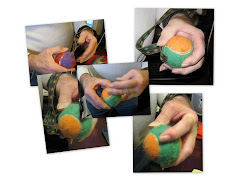
For a simple hand stretching exercise, try the tennis ball between the fingers. 
Thumb and indexfinger
Roll to index and middle fingers
Then roll to middle and ring finger
The ring and pinkie are the hardest
Although you feel as if you should be squeezing the ball, stretching is better for PD