Showing posts with label Parkinson's supplements. Show all posts

Friday, March 13, 2009

Questions About Parkinson's Disease Part V - Depression & PD

Parkinson's Depression and the three molecules of depression: serotonin, norepinephrine and dopamine

Depression is a common problem for many people - we hear those ads on television every day along with the side effect warnings. Parkinson's patients, their families and caregivers alike may go through periods of depression. The remedies and treatments for PDer and the carer may differ because of medication and supplement interactions and the disease itself.

Some research has indicated that the chemical changes in the brain caused by depression might actually be a trigger for PD. We know that Parkinson's shows itself after a significant loss of the neurotransmitters dopamine and norepinephrine; is serotonin deficiency occurring at the same time or earlier? One view is that synaptic depletion of serotonin allows a fall in norepinephrine levels. Which might mean that manipulating serotonin levels would increase norepinephrine levels if the norepinephrine depletion hadn't occurred because of the dopamine depletion. Which is why depression treatment can be different in Parkinson's disease.

Depression is often one of the 1st symptoms of PD - long before any obvious ones. Older patients can also manifest confusion, memory loss and apathy. PD is not the only disease associated with depression; Alzheimer's disease, kidney failure, stroke, AIDS, chronic fatigue, fibromyalgia, cancer and hypothyroidism patients also suffer from depression.

The PD symptoms for depression range from lack of energy, a struggle to arise to begin the new day, sleep disturbances, feeling irritable and anxious, have a sense of the loss of self-worth, feeling of self-guilt and loss of appetite. Because depression often manifests early it may seem to everyone that it is an extension of the appearance of Parkinson's Disease symptoms and the diagnosis. The depression may come and go. In the late stages depression may actually be caused by a chemical imbalance.

It is understandable that people would be depressed by having any disease because there is the shock, the grief and the sometimes not so subtle physical changes. There are differences in PD. A primary difference is that the depression over loss of mobility and appearance of other motor symptoms may actually acerbate the symptoms.

Psychological therapy such as cognitive-behavioral therapy as opposed to psychotherapy can be of benefit to PD patients because it can help restore a more positive self image which can assist in improving caregiver and family relations as well. It can also help the patient focus on problem-solving rather than the loss.

There are also medications which help. Be aware, however, the Cleveland Clinic information suggested that amoxipine (Ascendin) can make PD symptoms worse. And there are others which can cause low blood pressure. Selective serotonin uptake inhibitors (SSRIs) are among the more recent, safer meds. However, recent a study showed that nortriptyline, a tricyclic antidepressant (TCA) which targets both serotonin and norepinephrine receptors was more effective in PD patients than paroxetine (Paxil) an SSRI. Tricyclics are older antidepressants which must be monitored closely for overdose

If you are taking Zelapar or Zydis selegiline, Eldepryl, Cipro (Ciprofloxacin) there are cautions about taking antidepressants, SSRIs and tricyclic antidepressants because of interactions and side effects. Prozac and Zoloft may cause anxiety, tremor and insomnia.

Much to our surprise, we read that electroconvulsive therapy ("shock" therapy) works more rapidly than medication and may actually help improve other PD symptoms in some cases.

Another important treatment is exercise. It will help both the the depression and the PD symptoms.

There are also supplements which can help. Remember that medications are not the only substances which can cause side effects. Food and dietary supplements also have side effects.

Most of us are familiar with St John's Wort. You can also find St John's Wort in combination with 5-HTP and vitamin B-6. L-5-Hydroxytryptophan crosses the blood brain barrier and is said to help relieve anxiety and depression as well as being a natural relaxant which also aids in insomnia. There is some evidence that 5-HTP should not be used with carbidopa. If you are taking Azilect, if you are combining with MAO1 inhibitors, you should make sure to consult your doctor before taking ST John's Wort or 5-HTP. (Currently Teva, manufacturer of Azilect, is working with the FDA to change the description to MAO-B inhibitor which can be more broadly prescribed.)

Because of the impact upon the three molecules, the big 3 monoamines of Parkinson's, it is important to discuss any supplements you are considering with your neurologist. Melatonin is another supplement which is used in low doses to treat depression because it is known to raise serotonin levels and to help adjust the sleep cycle. Supplements should not be taken without a discussion with your physician.
It is important to keep in mind that everything you take into your body, including the foods you eat, will interact with everything else you take. Some combinations are synergistic, they work well together and may amplify the benefits while combining others can cause serious side effects.

One last area to discuss is Seasonal Affective Disorder - SAD.
It isn't just the winter blues because you feel cooped in even when you have to go out and about. SAD is more serious than that. It affects patients and caregivers alike. Some people have SAD even in the spring and summer.

We'll talk more about SAD in the next post - better late than never.

Friday, March 6, 2009

Questions about Parkinson's Disease

Introduction to Questions about Parkinson's Disease

Earlier this week we received some questions from a student who was working on a project for school. Since it's easier to create a questionnaire when you already know the answers, we've revised the question list and are presenting it here with the introductory remarks we also provided.

Introduction Please understand that this patient is only in between phase 1 and 2 and hopefully with the help of the medications he is taking and the addition of supplements and physical-type therapy, we will be able to hold the PD where it is now for awhile. You should know that each patient will manifest symptoms in a slightly different way; certain symptoms may never appear in some patients. Some patients progress rapidly from stage to stage.

Advanced stage PD patients might not be able to answer your questions. At that point you might need to talk to the caregiver and even they might not be able to answer precisely for obvious reason that they are not in the mind of the patient. By this time dopamine levels in the brain have fallen so severely that the remaining neurotransmitter cells cannot function well enough to prevent contracture of the limbs and sometimes the torso. This is more common in patients with psychosis. At the advanced stage the dopamine auto-receptors do not seem to be functioning much if at all.

Another thing you should know is that there are usually undiagnosed precursor symptoms - symptoms which appear well before the standard identifiable symptoms of Parkinson's disease. These symptoms are not identified by either the patient or the physician as being disease related. One school of thought on this is that as the dopamine and subsequently the norepinephrine cells die and their neurotransmitting ceases, the limited dopamine resources are allotted to other body functions. Sense of smell, an early symptom, may be seen by the brain as being peripheral and therefore reduced or shut down.

Depression is another precursor symptom. Being depressed by having the disease is logical but having the depression or severe stress can be either a trigger or an early symptom. PD depression is not treated successfully in the standard ways because the source is different. There are no standardized test for dPD but there are existing depression tests which can be used.

Since Parkinson's, long thought to be an idiopathic disease, may actually be a genetic disease which can skip many generations until it responds to a trigger or a built-in trigger on a mutated gene - there are several associated with PD - it is commonly an older person's disease. The numbers of patients go up at each year over 65. There are also young-onset or early onset patients who manifest differently in many cases. Their response to meds are different also. And sadly there are also juvenile PD patients whose symptoms can manifest between 2 and 20 years of age. The last two groups have not received nearly enough attention in the past.

There are different courses of treatment for patients as some prefer to postpone levadopa medications in favor of levadopa agonists or diet, exercise and supplements. Many of the medications have side effects either short term or within a few years that impact a decision for that line of treatment. There is also some surgery which is about 50% effective in reducing the need for medication. Other courses of treatment include diet, natural supplements and types of physical therapy including exercise therapy, dance therapy, yoga, breathing, voice exercises, swim therapy and massage therapy.

Without these extras Steve's body would have stiffened far more than it has already. His massage therapist commented to him that she had never felt shoulders as stiff as his. We are working on that outside the therapy because without regular attention (once a week is not enough but certainly all that we can afford.) I perform a different procedure than the therapist. I was shocked the other day (the day before massage therapy) when his shoulders felt more like a car bumper than what shoulders should feel like. So I improvised and it helped. I did what was intuitive although contrary to what is recommended but it seemed to make a positive difference. I pulled back on his shoulders and then pushed forward against his shoulder blades. Next I moved his upper arms. I would like to say "gently" but it was not gentle. I raised both arms to touch his ears and then alternated with pulling the shoulders forward and back. I also deeply massaged the muscles on either side of his spine followed by moving his upper arms again.

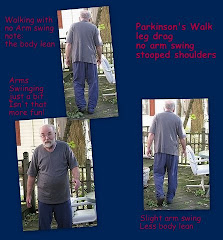
Within the next week we will be making another video of him walking outside (we need space for this) so that we can compare it to videos we made 3 1/2 years ago. Because he also has arthritis in his knees, especially on his weak/stiff side, that has had a profound impact upon his resistance to that pain. The same options for arthritis treatment on knees available to the average person with arthritis are not viable options for a Parkinson's patient.

We have designed other exercises to assist his balance and leg stiffness which affect his ability to walk normally. PD patients often shuffle rather than being able to bend all joints in a normal walk. He has to practice turning by lifting his legs rather than pivoting which aggravates pain in his arthritic knees. We also work on his breathing and his voice. We work on shoulders, arms and arm swing. Again, if you read some of the blog articles or look at the photos, you can see the symptomatic posture with lack of arm swing, difficulty sitting and walking.

He also takes several supplements about which we have written before. He takes CoQ10, Turmeric, Nettle Root, sublingual Glutathione, vitamin B complex, a multivitamin with almost no iron or other heavy metals, slippery elm and fenugreek and a few others. Some of them are obviously helping. For one month we added a zinc ascorbate with vitamin C to help restore a bit of his sense of smell...which it has. He won't take that again for another month or two because taking for longer is contraindicated.

TOMORROW: The Questionnaire
Followed by: PD Tests - The progression scales