Showing posts with label creatine. Show all posts

Sunday, September 27, 2009

My Parkinson's Disease and a Gluten-Free Diet: How I'm Doing

2 Months Gluten-Free with PD


It's been 2 months now since I stopped eating foods containing gluten, and while there have not been any block buster cures of major symptoms, in a general way I do feel better.

For financial reasons I've had to cut my massage from 4 times a month to 2 sessions. My range of motion and lack of rigidity and stiffness have remain improved, especially in my more affected left arm and hand and shoulder. This may be helped because I am now taking creatine and CoQ10 together. My feeling is that there is a help on several fronts but that the gluten-free diet has facilitated the good results.

Some of my allergy symptoms have gone away or decreased. I went the gamut of runny nose, sneezing, coughing, breathing difficulty from clogged airways and being repeatedly asked by you-know-who to clear my throat when speaking. Okay, I really didn't pay that much attention to it but I did take Claritin often so that I wouldn't have to think about the allergy signs. I can't remember  the last time I struggled to extricate one of those tiny pills from its blister-type packaging. While I still have occasional post nasal drip, it's no big deal - I'm in northeast Ohio. 

I still am experiencing some urinary frequency but am only having to get up 2 times during the nights compared to 4 or 5 before. Now I go to bed at 11:00 pm and wake around 1:00am and again at 4:00am, I dream more and have fewer illusions (left over from Mirapex). No vivid dreams at all.

Sexually I feel better because I can feel more and I stay harder longer. I just started taking the pycnogenol and L-arginine pills I had ignored for a year. I am taking this combination for the anti-inflammatory and anti-oxidant properties and find that it helps sexual dysfunction also. As a matter of fact this particular little blue pill is marketed just for that reason.

Everyone knows that I worried about keeping the comfort foods. Just the other morning I facetiously told Marge that I wanted french toast for breakfast. And about 20 minutes later there it was. Rice bread lends itself well to french toast. Gluten-free cheese puffs and chocolate chip cookies (from bean flours) are great snacks when I'm not having fruit. Tonight we'll have spaghetti from brown rice pasta. A new favorite is refried beans mixed with a spicy salsa and gluten-free turkey sausage.

I think the diet has helped me get my constipation problems under control. I am regular now and it doesn't take a whole day or two to get there.

Staying on the diet isn't too hard, not as hard as stopping smoking which I did almost 30 years ago. And I seem to have a better frame of mind.

Tuesday, September 1, 2009

Mix and Match with Parkinson's Disease Co-drugs

Creatine Combos for PD
Parkinson's disease is different things to different people, sort of like the old one about the blind men and the elephant. Some of us follow doctor's instructions to the letter while others, myself included, are constantly stirring the mix to find something that not only slows the progression but also appears to reverse symptoms.

So I tried creatine (see: Creatine note below) again, only this round I am pairing it with the CoQ10 doses which I already take. I'm trying to take smaller amounts of CoQ10 but more often throughout the day as apparently it has some diminishing returns in large doses. To that mix I just added St John's Wort (standardized hypericum 0.3%) with an enzyme delivery system.

I tried the CoQ10-Creatine combination first but I am impatient and wasn't sure I felt any results. So I added St John's Wort a couple of days ago. Yes, we did read about the "cheese effect" for tyramine and St John's Wort but for now I'm operating under the FDA opinion that MAO-B and MAO-A really are different in effect. (And subsequent to this post, the cheese warning was removed by the FDA from Azilect, my MAO-B inhibitor)

Although it has only been a few days, I think that I am less stiff; I can see and feel it in my left hand. That's my PD side. When we're driving somewhere, that's the hand my wife takes when she notices it is looking claw-like and separates the fingers, strokes and presses them down on my thigh. She's trying to make me aware of those muscles in a nice way. Sometimes she encourages me to do finger-stretching exercises in the car. Now that I have added St John's Wort to the mix, there seems to be less tension in that hand.

Do I think this change is due to the addition of St John's Wort, not really. It takes a minimum of a week to six weeks for this herb to be effective, the average is about a month. Plus the fact that I began at 600 mgs a day and not 900 mgs will also delay the onset of effectiveness...if any...No, I credit the change to the addition of creatine.

Creatine was named by French chemist Michal-Eugene Chevreul in 1832 while working as professor of chemistry specializing in the study of fatty acids at the Musee d'Histoire Naturelle. It was here that he isolated creatine as a component of skeletal muscle by extracting it from meat (muscle tissue). Twelve years later, a German scientist Justus von Liebug noticed that wild foxes (those who hunt for survival) had more intramuscular creatine than captive foxes who expended little energy to obtain food or escape predators. This has interesting implications in Parkinson's where the majority of patients appear to come from a more sedentary lifestyle.

So what do we know about creatine and CoQ10?

We know that CoQ10 is an important antioxidant because of its ability to transfer electrons. We know that the mitochondria within the cell need both CoQ10 and creatine to produce cellular energy because they function in different ways to assist that process. We also know that Parkinson's disease can be viewed as a mitochondrial disorder with decreased production of ATP (adenosine triphosphate) which has been called "molecular currency" and "the energy currency of life" without which muscles will not contract.

More than one study has pointed out the neuroprotective effects of the combination of adding creatine and CoQ10 to fight against dopamine depletion and the loss of tyroine hydroxalase neurons in the substantia nigra. In addition the addition of creatine and CoQ10 demonstrated a reduction of Lipid peroxidation - significant because that means a reduction of cell damage. It improved glutathione homeostasis with an overall effect of improving motor performance.

There are other combinations which have been the subject of study. In 2007 there ws an early PD study of CoQ10 and GP-1485, an immunophilin compound. By 2006 Symphony Neuro development Company stopped an open-label study of GP-1485 for regeneration of damaged nerves finding no demonstrated benefit.

A study of minocycline and creatine did demonstrate some benefit for ALS rat models but alone, minocycline alone did not demonstrate improvement in preventing cell death in HD models.

Creatine note: It took several years to find the "right" creatine.  At the time this article was written we were still going by trial and mostly error.
In 2010 we discovered that a smaller particle creatine monohydrate was effective in restoring slight arm swing and maintaining some muscle strength.
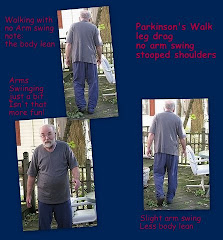
In 2011 we purchased pharmaceutical grade micronized creatine monohydrate and saw a dramatic change in left arm swing, should engagement (making an improvement in balance as a result) and muscle strength retention.

resources and additional reading:
The Value of combination therapies
Beneficial effects of creatine, COQ10, and lipoic acid in mitochondrial disorders
Creatine and CoQ10
Combination therapy with coenzyme Q10 and creatine produces additive neuroprotective effects in models of Parkinson's and Huntington's diesases
Beneficial effects of creatine, CoQ10 and lipoic acid in mitochondrial disorders
The Creatine Clinical Trial site at NIH
A randomized clinical trial of coenzyme Q10 and GPI-1485 in early Parkinson disease
From Harvard: Additive Neuroprotective Benefits of Minocycline with Creatine in a Mouse Model of ALS
Results of the above trial on Minocycline with Creatine - 2006
Parkinson's CoDrugs for Levadopa: Caffeic Acid and Carnosine
Creatine: The Power Supplement by Melvin H Williams, PhD; Richard B Kreider,PhD; and J David Branch, PhD is available online
Creatine

Addendum
We recently viewed an online Webinar in which Creatine was mentioned as possibly being neurprotective. We'll add updates as we learn of them.

Tuesday, August 25, 2009

Will Creatine Slow Parkinson's Disease Progression?

Having the energy to prevent PD cell death

Parkinson's patients have been taking creatine for years. It is a protein produced by the liver combining the amino acids, arginine, glycine and methionine to store cellular energy. Some forms of creatine produce creatine phosphate which is an energy source for nerve cells. The theory is that the energy created will help prevent mitochondrial loss - cell death - which is characteristic of Parkinson's Disease, ALS, Huntington's and muscular dystrophies.

Creatine is not a one dose fits all nor is it without side effects. Some of the side effects include dehydration, cramps, nausea, gas, diarrhea, renal stress and lowered blood pressure. Often lowered blood pressure will produce dizziness.

In 2000 an NIH sponsored trial of Creatine and the antibiotic, Minocycline, for ALS showed promise and suggested that further study was needed for Parkinson's. In that 12 month study patients received 200 mgs of minocycline and 10 mgs of creatine daily or a placebo. The minocycline was not well tolerated. The trial indicated the need for a study larger than 200 participants.

In March 2007 the National Institute of Health (NIH) - NINDS announced sponsorship of a phase III clinical trial to see if Creatine can slow the progression of PD. The trial is huge and will be enrolling 1720 people at 51 medical centers in North America. The trial is currently enrolling.

The first of a series of clinical trials from laboratory research to clinical trials under the heading of NIH Exploratory Trials in Parkinson's Disease (NET-PD), this trial will run between five to seven years. It is being led by Dr Karl Kieburtz of the University of Rochester and Barbara C Tiley, PhD of the Medical University of South Carolina in Charleston.

Body builders have been taking creatine for years to improve exercise performance and build muscle. There have been studies which imply that creatine can improve mitochondria function and may function as an antioxidant to reduce oxidative stress. In PD lab mice creatine has already been demonstrated to prevent loss of specific cells.

In the past I've taken different forms of creatine but have only noticed that I feel somewhat dizzy. I'm considering taking it again but in combination with at least CoQ10.

In this trial progression will be measured using the standard rating scales of quality of life, ability to walk, cognitive function and the ability to carry out other activities of daily living.

Who will be eligible: people diagnosed with PD within the last 2 to 5 years AND are being treated with levadopa or other medications which increase dopamine levels in the brain. Only half of the patients will receive creatine in this double blind study. The trial is using 5 mgs daily of creatine supplied by Avicena Group, Inc

People interested in participating in this study can obtain more information by calling 1-800-352-9424, emailing or visiting the clinical trial site at NIH. You can check for a nearby location at the NIH website.

Next we will look at creatine in combination with other additives including CoQ10.

references:
Press Release
The Minocycline-Creatine trial