Arm Swing Exercise for Parkinson's Disease
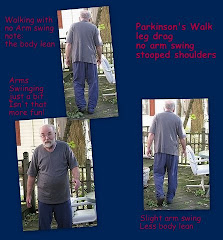
Since PD patients are often stiffer and weaker on one side in the earlier stages of PD, one of the things that suffers is gait which is somewhat dependent upon the arms for balance. If the arms don't swing, the stride usually shortens to compensate for the lack of shoulder and arm movement as well as the leg stiffness on the "bad" side. And of course, balance also becomes problematic.
Just telling yourself to swing your arms is not going to do it. You have to practice through exercise...regularly!
Sit in a chair - preferably a chair without arms - or one narrow enough that your arms can hang over the sides
Can you swing both arms? Together? In opposition?
If you can't, here's the exercise. You might need an assistant.
This is pretty simple but not necessarily easy.
If you have trouble, your assistant should hold the stronger arm in place while you work the weaker side.
Don't let the stronger side arm move. Just hold while the weaker-stiffer side performs the exercise once.
After the shoulder raises - the Shrug - is completed and the Forward and Back is also performed - release the arm
Get the shoulders moving first - we've done this before - the shoulders will help to propel you as well as provide balance.
Sit tall - head up - eyes forward
Raise the shoulders - let fall - raise both shoulders and let fall
Now alternate: raise the right shoulder only - let fall
Then the left shoulder: rise and fall
Together up and down - up and down
Shake it out
Sitting erect in your chair - head up - eyes forward
Swing your right arm front to back - reach back - swing forward
The shoulder will assist as it rises and falls with the swing.
Now repeat with the left arm
Next you will try alternate arm swing using both arms
Get the weaker side going first: forward-back-forward
Now the stronger side: forward-back
Keep the shoulders involved with the swing.
Now we're going to march in place with the arms swinging.
Sit erect - knees and feet comfortable apart for your march
(March them out now to that place)
Just as your assistant held your strong arm in place, if you have a problem raising the leg from the hip,
the strong leg should be held in place while you raise the weaker leg a few times. Release the leg
Lets March in Place.
Get the march going by raising first one leg from the hip, stepping down (heel first) and repeating with the other leg
Add the arm swing.
Music Maestro:
http://www.dws.org/sousa/works.htm
We're going to suggest the slower Wedding March for this exercise.
You might also like Riders for the Flag, Washington Post or the familiar Stars and Stripes Forever.
When you have completed your march with your arms swinging it is time to stand by leaning forward, rise from the chair
and march or walk down the hall or around the room.
Your stride goal is the one foot steps down a full foot length or more in front of the other.
If you have a freeze issue, your assistant must be ready with your key words to break the freeze and prevent a fall.
What we are doing with this exercise is similar to both the nautilus work favoring the weak side and the swim therapy marching with knees up and arms swinging except no equipment and no water.
The thing about Parkinson's is that unlike recovering from an injury or surgery, the body will stiffen again. These exercises must be done at least 3 times a week.
Did you know that 5-6 hours of vigorous exercise a week will raise the endorphin and dopamine levels? That should help ease some of your Parkinson's disease symptoms, however briefly.
Note: This is another in the series of exercises I designed to help Steve with his short stride. You will find that they are more strenuous than they might appear at first glance.
Marge
Showing posts with label arm swing. Show all posts
Showing posts with label arm swing. Show all posts
Thursday, February 26, 2009


Thursday, October 30, 2008
BASIC EXERCISES FOR PARKINSON'S - MY TOP 10
NAVIGATING SAFELY THROUGH THE DAY
While these may not look like the exercises that you expected, they are the basics for people with Parkinson's and other neuro-motor diseases. We cover walking, turning, balancing, sitting, rising, arm swinging, daily tasks and yawning.
1. Toes up. No, I'm not asking you to be a leprechaun but just to remember that when you are taking a walking step: the motion is heel to toe. You rock forward. Your foot does the heel-toe roll.
Try it slowly with the weight shift to the off leg, putting your heel on the floor and then rocking forward to your toe, weight shift and ready to repeat with the other foot.
As you do take that heel and toe roll, you will feel your calf and ankle muscles stretch. That stretch will get you out of trouble when your calves cramp as they do in PD. Just heel and toe to work it out. This will also work for the "freeze" if you just put your heel down and your toe up. You will be able to work it through because you have practiced, practiced, practiced.
When you hear that foot drag, you are probably walking toe to heel... to trip.
The problem with wearing high heels is that your legs and feet are always in that toe-heel position and you can feel the pain in your calf muscles. As a general rule high heels and PD don't mix.
2. Broader wheel base to prevent tipover If you hear your pant legs brushing together with evey step you take, your legs are too close together. The optimal distance for your legs to be apart is about 10 inches. This will aid your balance and prevent falling.
3. Long Strides for walking - Short steps for turning. Practice by walking several strides and then turning and walking back. Repeat. A few times a day for a total of at least 15 minutes. You will notice that the shorter steps - with feet still spread apart - will get you through the turn without the danger of tripping over a leg crossed in front. Those short turning steps will help you balance.
You are not a morotcycle, don't lean into the turn. Don't lead with your shoulders. Balance will come from good counterbalance.
4. Many PD patients are leery of tight spaces because of balance issues. Try walking into, through and out of those tight corners of a room. You are teaching yourself to overcome the fear - not to panic.
6. Get out into and of that chair. Easier said than done. So do it as rapidly as possible. Quit fighting with gravity. Sit Down slowly. Your body will be bent forward and your butt will touch the seat. Knowing where the seat is can be aided by "feeling" it with the back of your knee. (A stage sit) 5. Back to balance. You will be in public situations where there will be no wall or hand rail to support or catch you if you fall. You need to practice walking rapidly, stepping heel first with toe up, legs spread apart. Turn left, turn right, turn around. Don't hug the wall. Do the expectant father pace several times a day. Each time you stride try to lift you leg higher as if marching. That stretching is important with a disease that tightens your muscles.

 Yawning opens the shoulders, that is it relieves some muscle tension by the very act of yawning. It may stretch the lung tissues and increase the heart rate. It also frees the diaphragm. And here is where it is really important, it is a step towards clearer speech. By opening the throat it helps you avoid choking by eliminating swallowing problems. And don't just yawn, pandiculate. Get your arms and shoulders involved in the stretching that comes with a real yawn. You see it on TV. Arms out at the shoulders, hand to the mouth. Throw out your chest and stretch back from the shoulder blades. Feel your throat opening.
Don't yawn alone. If possible get someone to yawn along with you. It is contagious so beginning with a fake yawn will usually result in real and productive yawns.
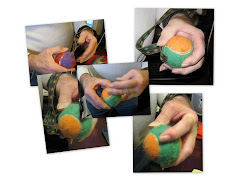
 For a simple hand stretching exercise, try the tennis ball between the fingers.
Thumb and indexfinger
Roll to index and middle fingers
Then roll to middle and ring finger
The ring and pinkie are the hardest
Although you feel as if you should be squeezing the ball, stretching is better for PD
While these may not look like the exercises that you expected, they are the basics for people with Parkinson's and other neuro-motor diseases. We cover walking, turning, balancing, sitting, rising, arm swinging, daily tasks and yawning.
1. Toes up. No, I'm not asking you to be a leprechaun but just to remember that when you are taking a walking step: the motion is heel to toe. You rock forward. Your foot does the heel-toe roll.
Try it slowly with the weight shift to the off leg, putting your heel on the floor and then rocking forward to your toe, weight shift and ready to repeat with the other foot.
As you do take that heel and toe roll, you will feel your calf and ankle muscles stretch. That stretch will get you out of trouble when your calves cramp as they do in PD. Just heel and toe to work it out. This will also work for the "freeze" if you just put your heel down and your toe up. You will be able to work it through because you have practiced, practiced, practiced.
When you hear that foot drag, you are probably walking toe to heel... to trip.
The problem with wearing high heels is that your legs and feet are always in that toe-heel position and you can feel the pain in your calf muscles. As a general rule high heels and PD don't mix.
2. Broader wheel base to prevent tipover If you hear your pant legs brushing together with evey step you take, your legs are too close together. The optimal distance for your legs to be apart is about 10 inches. This will aid your balance and prevent falling.
3. Long Strides for walking - Short steps for turning. Practice by walking several strides and then turning and walking back. Repeat. A few times a day for a total of at least 15 minutes. You will notice that the shorter steps - with feet still spread apart - will get you through the turn without the danger of tripping over a leg crossed in front. Those short turning steps will help you balance.
You are not a morotcycle, don't lean into the turn. Don't lead with your shoulders. Balance will come from good counterbalance.
4. Many PD patients are leery of tight spaces because of balance issues. Try walking into, through and out of those tight corners of a room. You are teaching yourself to overcome the fear - not to panic.
6. Get out into and of that chair. Easier said than done. So do it as rapidly as possible. Quit fighting with gravity. Sit Down slowly. Your body will be bent forward and your butt will touch the seat. Knowing where the seat is can be aided by "feeling" it with the back of your knee. (A stage sit) 5. Back to balance. You will be in public situations where there will be no wall or hand rail to support or catch you if you fall. You need to practice walking rapidly, stepping heel first with toe up, legs spread apart. Turn left, turn right, turn around. Don't hug the wall. Do the expectant father pace several times a day. Each time you stride try to lift you leg higher as if marching. That stretching is important with a disease that tightens your muscles.

 |
| Reach for the chair |
8. Listing to one side. Since it is often difficult to find the vertical with your eyes and ears, let your body find it with the following exercise. While you are doing your striding and turning exercises carry a tote bag with books on the opposite side of the list. The additional weight should help to compensate for the lean. Let your body feel the straightness you achieve so that you can walk that way without a heavy weight.
7. Swing your arms Yes, both of them. Lots of good reasons. Practice by sitting in an armless chair and just swing. Now get out of that chair and stride across the room while you swing both arms. It will loosen the muscles, aid your balance, generally make you feel better by lessening fatigue. If you are already having difficulty moving one arm, get your arms moving before you begin to walk. It may sound odd but when you first try to walk and swing your arms, you will find it is easier if your arms are already in motion.
Warm up: Stretch your arms as high as you can before you begin the weight carry. Feel the stretch in your arms, neck, chin, shoulders, spine, stomach, small of your back and gluteal muscles. The better the stretch, the more you will feel it throughout your body. Don't overstretch, this is a warm up.
Perhaps it is buckling your seat belt. Practice 10 to 20 times every time you are in the vehicle. You have to consciously relearn that which may be hidden in your brain.
10. Yawn. Oh good grief! Just keep yawning that big, rude fake yawn until your body picks it up naturally yawns. But why yawn? One theory is to induce more oxygen into the body and to expel carbon dioxide. Paratroopers often yawn before jumping and Olympic athletes are known to yawn before competition.
7. Swing your arms Yes, both of them. Lots of good reasons. Practice by sitting in an armless chair and just swing. Now get out of that chair and stride across the room while you swing both arms. It will loosen the muscles, aid your balance, generally make you feel better by lessening fatigue. If you are already having difficulty moving one arm, get your arms moving before you begin to walk. It may sound odd but when you first try to walk and swing your arms, you will find it is easier if your arms are already in motion.
 |
| Reach higher |
Warm up: Stretch your arms as high as you can before you begin the weight carry. Feel the stretch in your arms, neck, chin, shoulders, spine, stomach, small of your back and gluteal muscles. The better the stretch, the more you will feel it throughout your body. Don't overstretch, this is a warm up.
 |
| For finer finger tasks |
9. Daily tasks are becoming difficult. If you are having problems buttoning your shirts you can buy an entirely new wardrobe and go western with snaps or you can retrain your fingers to button the shirts in your closet. Put on a shirt and button and unbutton 5 times the first day, 10 times the next, 15 times for the next session and finally 20 times. You will find that it becomes easier with repetition. You will have to bring this exercise back into your regimen many times as your PD progresses. My wife made me do this 20 times the first day but I think that easing into it would be better.
Perhaps it is buckling your seat belt. Practice 10 to 20 times every time you are in the vehicle. You have to consciously relearn that which may be hidden in your brain.
10. Yawn. Oh good grief! Just keep yawning that big, rude fake yawn until your body picks it up naturally yawns. But why yawn? One theory is to induce more oxygen into the body and to expel carbon dioxide. Paratroopers often yawn before jumping and Olympic athletes are known to yawn before competition.

Don't yawn alone. If possible get someone to yawn along with you. It is contagious so beginning with a fake yawn will usually result in real and productive yawns.

Thumb and indexfinger
Roll to index and middle fingers
Then roll to middle and ring finger
The ring and pinkie are the hardest
Although you feel as if you should be squeezing the ball, stretching is better for PD
Sunday, October 26, 2008
WATER THERAPY SESSIONS FOR PARKINSON'S
Aqua Therapy exercises for maintaining PD balance

I try to get there 20 minutes before the scheduled time of my session because I never know how long it will take me to get dressed. In the men's locker room I remove my shoes and socks, unbutton and take off my shirt, slacks and underwear and then put on my swim suit. Sometimes it can take 5 minutes apiece to remove my shirt and pants; I'm still not used to that frustration but it is part of PD.
I meet up with Barb my therapist in the hall to the pool. I walk down a flight of stairs with handrails on either side and step into the pool. I always have trouble with that first step but Barb is watching out for me. If I were in a wheel chair I could use the lift to be lowered into the pool.
The first exercise is walking to the other end of the 60 foot pool and back, then walking it backwards and sideways. This is warm up. Other walking exercises follow. These are designed to improve my gait and include swinging both of my arms. It is a special lesson for my left arm.
During my first session, while walking the pool I met a group of Russian Americans. I was alarmed at first because I could not understand what was being said - now what sense am I losing? - but then I recognized one word "horses" and realized their therapist was instructing them in Russian.
Next exercise is marching from one end to another with knees stepping high like a Rockette . Good stretching. Next as I hold onto the side of the pool, I do leg lifts, right leg, left leg in all directions.
Then Barb has me step away from the side and exercise my arms against the resistance of the water. I can feel that exercise testing my balance. In another exercise I have to perform a bicycle motion with my legs as I hold onto the edge of the pool. It is the most complicated exercise. I could feel that in my shoulders which was unexpected.
There were also a couple of exercises which I've forgotten already. But they did not forget me because by the next day I could feel some aching of muscles which I had not been using.
After I had completed my exercises Barb told me I could stay in the water and walk around to continue cooling down, which I did, walking in circles in the same way that I used to cool down horses after riding.
I have Kaiser Medicare Plus, the co-pay is $10.00. I go back next week for the next two sessions.
Since the last session I found that I can wear shoes around the house. I hadn't been happy wearing even the most comfortable shoes in the last month; despite the cold, I had been barefoot, but no longer.

I've gone to my first and second aqua therapy sessions.
I try to get there 20 minutes before the scheduled time of my session because I never know how long it will take me to get dressed. In the men's locker room I remove my shoes and socks, unbutton and take off my shirt, slacks and underwear and then put on my swim suit. Sometimes it can take 5 minutes apiece to remove my shirt and pants; I'm still not used to that frustration but it is part of PD.
I meet up with Barb my therapist in the hall to the pool. I walk down a flight of stairs with handrails on either side and step into the pool. I always have trouble with that first step but Barb is watching out for me. If I were in a wheel chair I could use the lift to be lowered into the pool.
The first exercise is walking to the other end of the 60 foot pool and back, then walking it backwards and sideways. This is warm up. Other walking exercises follow. These are designed to improve my gait and include swinging both of my arms. It is a special lesson for my left arm.
During my first session, while walking the pool I met a group of Russian Americans. I was alarmed at first because I could not understand what was being said - now what sense am I losing? - but then I recognized one word "horses" and realized their therapist was instructing them in Russian.
Next exercise is marching from one end to another with knees stepping high like a Rockette . Good stretching. Next as I hold onto the side of the pool, I do leg lifts, right leg, left leg in all directions.
Then Barb has me step away from the side and exercise my arms against the resistance of the water. I can feel that exercise testing my balance. In another exercise I have to perform a bicycle motion with my legs as I hold onto the edge of the pool. It is the most complicated exercise. I could feel that in my shoulders which was unexpected.
There were also a couple of exercises which I've forgotten already. But they did not forget me because by the next day I could feel some aching of muscles which I had not been using.
After I had completed my exercises Barb told me I could stay in the water and walk around to continue cooling down, which I did, walking in circles in the same way that I used to cool down horses after riding.
I have Kaiser Medicare Plus, the co-pay is $10.00. I go back next week for the next two sessions.
Since the last session I found that I can wear shoes around the house. I hadn't been happy wearing even the most comfortable shoes in the last month; despite the cold, I had been barefoot, but no longer.
Subscribe to:
Posts (Atom)


 Posts
Posts