What Can Be Done to Correct PD Postural Instability and balance
For the past year and a half, I've been getting a Swedish massage at least 3 times a month because it reduces the arthritic pain in my knees. This is pain that keeps me from being able to walk very far - like out to the car in the parking lot, or exercise as much and as hard as I want. The massage therapist has spent hours on the stiffness and muscle knots in my shoulders. The massage allows me to avoid taking pain killers, prescription or over the counter.
Massage provides many benefits. For this person with Parkinson's disease, it reduces the rigidly and stiffness of the PD affected muscles in my left side neck and shoulder, arm and hand. When it's been a couple of weeks between massages, I have more difficulty getting in and out of the car and the shower. After the massage it is easier for me to get my legs between the rollers in the leg extension and leg curl machines at the therapy center.
The massage therapist can feel stiffness in my body that I haven't felt yet or have forgotten about. This week she was concerned about my posture, the fact that I walk or sit with my head down. Not good.
For the past year and a half, I've been getting a Swedish massage at least 3 times a month because it reduces the arthritic pain in my knees. This is pain that keeps me from being able to walk very far - like out to the car in the parking lot, or exercise as much and as hard as I want. The massage therapist has spent hours on the stiffness and muscle knots in my shoulders. The massage allows me to avoid taking pain killers, prescription or over the counter.
Massage provides many benefits. For this person with Parkinson's disease, it reduces the rigidly and stiffness of the PD affected muscles in my left side neck and shoulder, arm and hand. When it's been a couple of weeks between massages, I have more difficulty getting in and out of the car and the shower. After the massage it is easier for me to get my legs between the rollers in the leg extension and leg curl machines at the therapy center.
The massage therapist can feel stiffness in my body that I haven't felt yet or have forgotten about. This week she was concerned about my posture, the fact that I walk or sit with my head down. Not good.

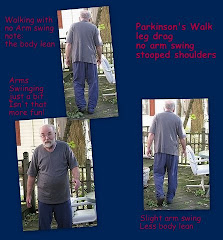
So I took off my prism reading glasses, put on the every-place-else trifocals, set down my cane and marched up and down the hall with my head held higher. And what do you know, my wife said my stride was longer and my gait twice as fast!
This reminder isn't new to me. Back in the day when our son played hockey, at the coaches request I made a plywood barricade to hang on front of the goal cage for shooting practice. The barricade had openings at the four corners for the entry of the successful puck. I painted it black and in large white letters we printed LOOK UP as a reminder for the shooter to keep his eyes not on the puck but on the goal.

Abraham N Lieberman, MD, at the Mohamed Ali Center in Phoenix, AZ, judges morbidity by a patient's posture. Those with their heads down in their 70s will not be alive in their 90s. So I'm trying to concentrate on that. I keep having mental images of the bad posture of PWPs I have met at the physical therapy center and at the support group, several bent close to 90 degrees. I really don't want to end up like that but I don't know if I have the resolve to keep my head up enough to avoid it, even though postural instability is a quality of life or death matter for me.

Addendum: We recently read an 2007 article entitled Impaired vertical postural control and proprioceptive integration deficits in Parkinson's disease and feel that there is more to think about on the issue of balance and PD and the specialized requirements of a PwP. We'll be posting that article on or before 2/25/2010


 Posts
Posts