Showing posts with label CoQ10. Show all posts

Friday, June 17, 2011

Random Thoughts and Ideas about Parkinson's Disease

PD is always with us even when we ignore it

An apology is in order for the dearth of posts lately. We've been tweaking past posts and side column information and now we'd like to share some random thoughts we've had recently.


Lifestyle aids - If you look hard enough you'll find several interesting products including scissors. At one point in our household there were two lefties. One had to have a lefty scissors, the other couldn't use one. But this is different. There is a long reach scissors for helping with toenails. We don't know if it is really long enough but it might help. There is also a table top mounted scissors which might help for those who can only use one hand.


We wrote about other basic assistive devices a few years ago. It's always a good idea to keep checking because people are always finding clever ways to help adapt to PD issues. We would appreciate your input on experience with adult incontinence underwear brands through your comments below or by email.


Toe Cramps? If a calcium/magnesium along with a potassium supplement doesn't work, perhaps Gel Flex Toe Stretchers or YogaPro Yoga Toes might help. They look sort of like the foam pads I tried to use for separating my toes to keep nail polish from smearing. Would those work too? Those will cost about $2.00 for a pair.

The laser mobility walker for Parkinson's disease. Made by U-step who also makes a laser cane, these walkers are not inexpensive although you can still get considerable support form Medicare for their purchase. This is a heavy duty walker with seat and basket, the laser device which helps to break a freeze can be purchased separately.

We've only mentioned medical alert tags once, but the more we read anecdotal experiences, the more we realize just how important these dog tags, pendants, wallet cards, bracelets can be. It is important that the information be on the tag itself. There are several companies which can create this identification for you. Consider how symptomatic you might become or how painful withdrawal might be if medical personnel did not have your medication information upon admission to the hospital...or even before that.

Multi-tasking. In ADHD low levels of dopamine prevent a child from focusing - is that similar to the lowered ability of PwPs to multi-task?

Saw this little guy down the street
We were delighted to see him
No imagination required
Hallucinations vs imagination How do we distinguish between seeing faces and animals in the cloud shapes and hallucinating that we are Seeing Faces in clouds, carpets and patterns when dopamine levels are elevated? "Life isn't about waiting for the storm to pass. It's about learning to dance in the rain." "Will you, won't you, will you, won't you, will you join the dance?" And if not the dance, will you walk or march with me?

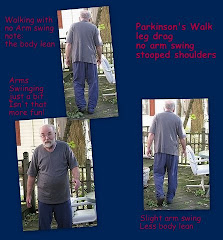
Walking and arm swing - did you know that it takes more energy to walk with your arms still than to swing them? Arm swing helps to counterbalance the body - keeping your hips from twisting too much. It has been learned that if you walk with the leading leg and the arm swing on the same side of the body (think Pacer in horse racing) it actually requires 25% more energy than a normal walk with leading leg and opposing arm swing. So where is it in the brain? As evidenced by DBS surgery and possibly PD levodopa treatment, upper arm locomotor synergies are influenced by the basal ganglia.

Steve has been taking a different form of Creatine for the last few weeks and has regained a small amount of arm swing on that PD side. Although we switch brands of supplements from time to time, we're going to be sticking with CreaSol, a flavored powder which is mixed with warm water. It is the micronized form of creatine monohydrate which is also available at about 1/2 the price, although a bit tricker to dissolve.


Ayruvedic medicine promotes walking as an activity which will bring the various energies of the body into balance. Walking is low impact and considered to be a healthy activity for all body types. We're glad to report that Steve has started taking walks again. This means that he has been reporting back on the garage sales and who is setting up a wedding tent in the back yard. Walking can be very valuable.


We know that the rhythm of the dance apparently helps people with PD move in ways their condition suggests they can no longer move. How do You walk to music? We know that music is an anxiotic -an anti-anxiety aid. We know that music can actually have analgesic properties. It can decrease heart rate, respiration rate, and blood pressure. Music has been used for therapy since early times. Rhythm is just one aspect which seems to be very helpful in PD. If you don't want to get out of that chair, listen to the music.

So what about melatonin, the nighttime hormone produced by the pineal gland? Is it just another push-me-pull-you of PD? Exposure to sunlight suppresses melatonin production. Melatonin release then inhibits the release of dopamine in specific areas of the central nervous system (hypothalamus, hippocampus, medulla-pons, and retina). It is possible that this in turn plays a role in the causation of PD since inhibition of dopamine will have consequences on bodily movements. Although the antioxidant effect of melatonin may offer neuroprotection for mitochondrial activity, the inhibition of dopamine release is not a goal of PwPs.


CoQ10 and Parkinson's disease. OK, CoQ10 trials have come to a halt. Co-enzyme Quercetin 10 does not slow the progression of PD. Steve found that it definitely made him feel better in the early years of his PD. He found that it did help with tremor easing. Did he think it was slowing progression? He felt that it was helping with symptomatic relief. And that in itself is significant. We need larger studies in the improvement of PD visual function because another small study had positive results.  Moreover, two studies for cardiac patients had positive results. In one CFS study, patients who took CoQ10 demonstrated a serious reduction in congestive heart failure symptoms and had required fewer hospitalizations. One heart transplant patient study had only minimally positive results while a shorter, smaller study had some positive results.

Steve and Rita on a walk in the park
Rhinorrhea or Rhinitis is increased in PD. Who would think that a runny nose would be symptomatic of PD but according to Dr Joseph H Friedman, that is exactly the case. They have not determined whether it is related to olfactory deficits as well but it is not only a symptoms but it can be a precursor symptom as well. I've noticed the increased need for throat clearing due to post nasal drip with Steve. Once he's done that, it is much easier to understand him when he speaks. Rhinorrhea in Parkinson's disease by Dr Joseph H Friedman, MD Rhinorrhea: a common nondopaminergic feature of Parkinson's disease.

Seborrhoeic dermatitis - autonomic symptom - immunodeficiency - aloe vera or coconut oil - crude diluted honey - avocado extracts and supplements such as lactobacillus, B vitamins: B7 (biotin), B6, B2, B3. Alternative treatment= apply milk of magnesia to face or scalp when showering (rinse off at end of shower)

Autonomic Neuropathy a form of peripheral neuropathy, is found in symptoms which occur when there is damage to the nerves which regulate blood pressure, heart rate, bowel and bladder emptying, digestion and impotence. So that helps to explain the Pd symptoms: constipation, urinary incontinence, urinary hesitancy, incomplete emptying of bladder and yes, RLS. It also helps to explain postural instability or dizziness upon standing or sitting up, hyperhidrosis (excessive sweating, difficulty swallowing.

In Parkinson's disease concerns are very real. Falling, weight loss leading to malnutrition, dehydration and electrolyte imbalance, choking. although rarely mentioned there is also a risk of kidney failure caused by urine back up accompanying incomplete emptying of bladder.


Steve loves marigolds
Which leads us to the symptoms of kidney problems which can lead to kidney failure if untreated. Headaches, aches and pains. Feeling tired all of the time. Loss of appetite. Bone and joint issues, itching and restless leg feeling. One problem is that a lower backache can be the only symptom and is associated more with stiffening muscles that with a kidney infection. It might be ignored. Anemia can develop because the red blood cell count is low. Low red blood cell count = low oxygen levels for cells. Insomnia/daytime sleepiness. The basic problem is that UTIs are common in latter stages of PD when organs begin to shut down and when catheters have become necessary. It is important for caregivers to be on the lookout for the signs.

Exercise aids - we've talked about the portable assisted pedaler in a previous post. We'll add the findings of other PD users as the reports come in. If you can  find a therapy center or club which has forced exercise on its program, join it! 

Voice Exercises - in the comfort of your own home, you can take Mary Spremulli's Voice Aerobics class on DVD. She also as Songbirds in an audio CD and offers The Breather to aid in breathing in and exhaling. Mary is a medical speech-language pathologist who has many years of experience in her field. Visit her website to learn more, you won't regret it.

On 9-18-11 we were sent a link for a pocket sized breathing exerciser:

Respiratory Muscle Strength Trainer, a simple hand-held device looking very much like a large whistle. Regular use should help improve the strength of the muscles used to inhale and exhale. Most everyone remembers having a whistle as a child. This devise might appeal to the aging but young at heart and demonstrate important therapeutic results.

Monday, October 19, 2009

Parkinson's Disease News Updates in Brief

Point and Click for PD updates  

From Parkinson's Action Network:

VA Secretary Supports Veterans with Parkinson's Disease Exposed to Agent Orange
Veterans Administration Establishes Presumption of Service Connection for Vietnam Veterans with PDM

Eric Shinseki, Secretary of Veterans Affairs, established that Parkinson’s disease will receive a presumption of service connection for disabled Vietnam veterans living with Parkinson’s disease.  Based on a July 2009 report by the National Academy of Science’s Institute of Medicine (IOM), this decision simplifies and accelerates the benefits application process for Vietnam veterans with Parkinson’s disease who were exposed to Agent Orange.  Now, Vietnam veterans with Parkinson’s disease applying for disability benefits do not have to prove an association between their illness and military service.
“The entire Parkinson’s disease community supports this decision by Secretary Shinseki,” said Amy Comstock Rick, PAN Chief Executive Officer.  “This will now allow our Vietnam veterans to receive the support and care they so rightly deserve rather than becoming experts on Agent Orange exposure simply to apply for benefits.”
...."available evidence supports a possible link between exposure to Agent Orange and Parkinson’s disease.  Along with Parkinson’s disease, the Secretary also established a service connection for B cell leukemias (such as hairy cell leukemia) and ischemic heart disease.  There are 12 other presumed illnesses recognized by the VA"
....."The U.S. Military Veterans with Parkinson’s (USMVP), a group of over 200 Vietnam veterans living with Parkinson’s disease, has championed this issue for years and has strongly advocated for VA benefits.  It was through their hard work and determination that Vietnam veterans exposed to Agent Orange will now receive the benefits due to them for their service."

Nutritional Supplements

Green Tea
Drinking five cups of green tea per day may reduce the incidence of psychological distress by 20 per cent, says a new study from Japan.
Green tea extracts may slow smokers’ lung damage

Omega 3

CoQ10
Supplements of coenzyme Q10 (CoQ10) may protect or retard the development of fatty liver related to obesity, suggest findings from an animal study
CoQ10 by any other name:
Andelir®, CoenzymeQ, Co-enzyme Q10, Coenzyme Q (50), CoQ, CoQ10, CoQ(50), Co-Q10, CoQ-10,
2,3 dimethoxy-5 methyl-6-decaprenyl benzoquinone, Heartcin®, idebenone (synthetic analogue),
Kaneka Q10™, mitoquinone, Neuquinone®, Qunol, Q-Sorb, Q10, Q-Gel®, Solu™ Q10, Taidecanone®,
ubidecarenone, ubiquinol, ubiquinone, ubiquinone-10, ubiquinone-Q10, Udekinon®, vitamin q10, vitamin Q10

Clinical Trial: Effects of Coenzyme Q10 (CoQ) in Parkinson Disease

Other News
Cogane
Cogane headed for Phase II trials
June 2010:  Phytopharm announced that it has received FDA protocol approval to procede with Cogane Phase II clinical trials. Enrollment will begin in late 2010.
You can read the Phytopharm press release here
Check back for the links to the enrollment links.

Forced Exercise
See PD Trials for contact information about the Dr Albert's Forced Exercise trial, The Therapeutic Effect of Exercise on Parkinson's disease, Study ID: 09-439

Sunday, September 27, 2009

My Parkinson's Disease and a Gluten-Free Diet: How I'm Doing

2 Months Gluten-Free with PD


It's been 2 months now since I stopped eating foods containing gluten, and while there have not been any block buster cures of major symptoms, in a general way I do feel better.

For financial reasons I've had to cut my massage from 4 times a month to 2 sessions. My range of motion and lack of rigidity and stiffness have remain improved, especially in my more affected left arm and hand and shoulder. This may be helped because I am now taking creatine and CoQ10 together. My feeling is that there is a help on several fronts but that the gluten-free diet has facilitated the good results.

Some of my allergy symptoms have gone away or decreased. I went the gamut of runny nose, sneezing, coughing, breathing difficulty from clogged airways and being repeatedly asked by you-know-who to clear my throat when speaking. Okay, I really didn't pay that much attention to it but I did take Claritin often so that I wouldn't have to think about the allergy signs. I can't remember  the last time I struggled to extricate one of those tiny pills from its blister-type packaging. While I still have occasional post nasal drip, it's no big deal - I'm in northeast Ohio. 

I still am experiencing some urinary frequency but am only having to get up 2 times during the nights compared to 4 or 5 before. Now I go to bed at 11:00 pm and wake around 1:00am and again at 4:00am, I dream more and have fewer illusions (left over from Mirapex). No vivid dreams at all.

Sexually I feel better because I can feel more and I stay harder longer. I just started taking the pycnogenol and L-arginine pills I had ignored for a year. I am taking this combination for the anti-inflammatory and anti-oxidant properties and find that it helps sexual dysfunction also. As a matter of fact this particular little blue pill is marketed just for that reason.

Everyone knows that I worried about keeping the comfort foods. Just the other morning I facetiously told Marge that I wanted french toast for breakfast. And about 20 minutes later there it was. Rice bread lends itself well to french toast. Gluten-free cheese puffs and chocolate chip cookies (from bean flours) are great snacks when I'm not having fruit. Tonight we'll have spaghetti from brown rice pasta. A new favorite is refried beans mixed with a spicy salsa and gluten-free turkey sausage.

I think the diet has helped me get my constipation problems under control. I am regular now and it doesn't take a whole day or two to get there.

Staying on the diet isn't too hard, not as hard as stopping smoking which I did almost 30 years ago. And I seem to have a better frame of mind.

Tuesday, September 1, 2009

Mix and Match with Parkinson's Disease Co-drugs

Creatine Combos for PD
Parkinson's disease is different things to different people, sort of like the old one about the blind men and the elephant. Some of us follow doctor's instructions to the letter while others, myself included, are constantly stirring the mix to find something that not only slows the progression but also appears to reverse symptoms.

So I tried creatine (see: Creatine note below) again, only this round I am pairing it with the CoQ10 doses which I already take. I'm trying to take smaller amounts of CoQ10 but more often throughout the day as apparently it has some diminishing returns in large doses. To that mix I just added St John's Wort (standardized hypericum 0.3%) with an enzyme delivery system.

I tried the CoQ10-Creatine combination first but I am impatient and wasn't sure I felt any results. So I added St John's Wort a couple of days ago. Yes, we did read about the "cheese effect" for tyramine and St John's Wort but for now I'm operating under the FDA opinion that MAO-B and MAO-A really are different in effect. (And subsequent to this post, the cheese warning was removed by the FDA from Azilect, my MAO-B inhibitor)

Although it has only been a few days, I think that I am less stiff; I can see and feel it in my left hand. That's my PD side. When we're driving somewhere, that's the hand my wife takes when she notices it is looking claw-like and separates the fingers, strokes and presses them down on my thigh. She's trying to make me aware of those muscles in a nice way. Sometimes she encourages me to do finger-stretching exercises in the car. Now that I have added St John's Wort to the mix, there seems to be less tension in that hand.

Do I think this change is due to the addition of St John's Wort, not really. It takes a minimum of a week to six weeks for this herb to be effective, the average is about a month. Plus the fact that I began at 600 mgs a day and not 900 mgs will also delay the onset of effectiveness...if any...No, I credit the change to the addition of creatine.

Creatine was named by French chemist Michal-Eugene Chevreul in 1832 while working as professor of chemistry specializing in the study of fatty acids at the Musee d'Histoire Naturelle. It was here that he isolated creatine as a component of skeletal muscle by extracting it from meat (muscle tissue). Twelve years later, a German scientist Justus von Liebug noticed that wild foxes (those who hunt for survival) had more intramuscular creatine than captive foxes who expended little energy to obtain food or escape predators. This has interesting implications in Parkinson's where the majority of patients appear to come from a more sedentary lifestyle.

So what do we know about creatine and CoQ10?

We know that CoQ10 is an important antioxidant because of its ability to transfer electrons. We know that the mitochondria within the cell need both CoQ10 and creatine to produce cellular energy because they function in different ways to assist that process. We also know that Parkinson's disease can be viewed as a mitochondrial disorder with decreased production of ATP (adenosine triphosphate) which has been called "molecular currency" and "the energy currency of life" without which muscles will not contract.

More than one study has pointed out the neuroprotective effects of the combination of adding creatine and CoQ10 to fight against dopamine depletion and the loss of tyroine hydroxalase neurons in the substantia nigra. In addition the addition of creatine and CoQ10 demonstrated a reduction of Lipid peroxidation - significant because that means a reduction of cell damage. It improved glutathione homeostasis with an overall effect of improving motor performance.

There are other combinations which have been the subject of study. In 2007 there ws an early PD study of CoQ10 and GP-1485, an immunophilin compound. By 2006 Symphony Neuro development Company stopped an open-label study of GP-1485 for regeneration of damaged nerves finding no demonstrated benefit.

A study of minocycline and creatine did demonstrate some benefit for ALS rat models but alone, minocycline alone did not demonstrate improvement in preventing cell death in HD models.

Creatine note: It took several years to find the "right" creatine.  At the time this article was written we were still going by trial and mostly error.
In 2010 we discovered that a smaller particle creatine monohydrate was effective in restoring slight arm swing and maintaining some muscle strength.
In 2011 we purchased pharmaceutical grade micronized creatine monohydrate and saw a dramatic change in left arm swing, should engagement (making an improvement in balance as a result) and muscle strength retention.

resources and additional reading:
The Value of combination therapies
Beneficial effects of creatine, COQ10, and lipoic acid in mitochondrial disorders
Creatine and CoQ10
Combination therapy with coenzyme Q10 and creatine produces additive neuroprotective effects in models of Parkinson's and Huntington's diesases
Beneficial effects of creatine, CoQ10 and lipoic acid in mitochondrial disorders
The Creatine Clinical Trial site at NIH
A randomized clinical trial of coenzyme Q10 and GPI-1485 in early Parkinson disease
From Harvard: Additive Neuroprotective Benefits of Minocycline with Creatine in a Mouse Model of ALS
Results of the above trial on Minocycline with Creatine - 2006
Parkinson's CoDrugs for Levadopa: Caffeic Acid and Carnosine
Creatine: The Power Supplement by Melvin H Williams, PhD; Richard B Kreider,PhD; and J David Branch, PhD is available online
Creatine

Addendum
We recently viewed an online Webinar in which Creatine was mentioned as possibly being neurprotective. We'll add updates as we learn of them.

Wednesday, July 29, 2009

Finding the Best Price for CoQ10 for Parkinson's Disease

Shopping for CoQ10 - Ubiquinone - Ubidecarenone
Coenzyme Q - Coenzyme Q10
As you may know, we've been buying the anti-oxidant CoQ10 at Costco for the last few years. They carried TruNature made using the trans isomer (natural) process and appeared to be one of the least expensive. Price is important when you are taking at least 1200 mgs per day. Whenever my wife is at Costco she checks for a sale price since I go through a bottle every two weeks.

So you can imagine her surprise when she discovered that the 150 mgs with 120 capsules had been discontinued. In it's place was another brand, also made with the trans process but with a much higher price tag. So she went shopping around online and this is some of what she found.

For those who do shop Costco, they now carry Nature Made - they do have a coupon but that may expire soon.

We've been buying some Nutraceutical Sciences Institute products through Vitacost and are happy with NSI. The NSI CoQ10 is $23.99 for 240 100 mg capsules. For me that means a daily cost of $1.20 per day down .59 from the $1.79 we were paying for TruNature. The shipping cost - if any - is offset by the lack of sales tax so we ordered a couple of bottles because we know that NSI is a natural.

Vitacost also provides a drug interaction service - in this case we linked with the CoQ10 interactions.

And then she found Puritan's Pride which carries a CoQ10 they call Q-Sorb. Right now they have some BOG2 and the price for three 60 count 200 mg bottles worked out to be $1.07 per day. She was able to get the verification of the Trans process (yeast to extraction to purification to crystallization to drying to packing) through the Live Chat at the Help Page-Contact Us - found it near the bottom of the page.

Swanson Health Products carries more than one brand. We received an early evening immediate response from Phillip E in Customer Care at Swanson Vitamins which impressed us:
Thank you for contacting Swanson Health Products! I am happy to help you!
All of our CoQ10 is from the trans-isomer.
All of our CoQ10 is natural and produced through a fermentation process.
Here is a link to the Swanson catalogue of CoQ10 products. We determined the lowest cost to be 100 count 100 mg capsules at $1.02 per day.

Because Swanson Health Products also carries NOW CoQ10, she also wrote to NOW Foods and received a prompt reply from the Science & Nutrition Group who also sent this link the next morning:
Our Japanese sourced CoQ10 material is the best quality,
highest grade Coenzyme Q10 available.
All trans- isomer produced via fermentation.
Also once this raw material is received it is then handled using

Good Manufacturing Practices.
Products are get tested for purity.
Microbiological and the values of heavy metals such as Lead, Arsenic, Cadmium,

Mercury, Aluminum are specified well as other impurities.
Because swallowing is such a serious problem in Parkinson's Disease, Swanson has a pdf format printable pill size guide which I find very useful. Of course they are one of the few companies to indicate the capsule size.

We know there are other companies out there but we're pleased with the process and the cost per day which we've listed here. We certainly hope that this helps your search.

We're aware that the dry form of CoQ10 may provide the most accessible benefit to the body. We're also aware that capsules are easier for me at this stage in the PD journey.

Thursday, April 30, 2009

Swine Flu and Parkinson's Disease

How can I strengthen my immune system when I have Parkinson's disease?

Because I worry about things over which I have no control, I worry about the latest flu which is being called Swine Flu (Human Swine Influenza Virus - SIV) although according to an article I just read, it should be called North American Flu because no pigs have been found with it yet and because the genes contain both human and bird viruses as well as two swine viruses. And pigs are susceptible although none have been found with this H1N1 virus thus far.

No matter what you call it, unfortunately because having Parkinsons weakens our immune systems. Parkinson's patients are at a greater risk of dying during an epidemic. There is no new flu shot for our protection now and the one many people got last fall or winter probably doesn't offer any protection either. The earliest date for a vaccine has been said to be next September. There are only two effective antivirals Tamiflu and Relenza (inhaler) and they are in limited supply, so we PD patients need to look to what we can do to increase our own chances of surviving.

Here are a few things you can do to increase your odds of avoiding the latest flu strain. Most of them are things we've been told to do many times before but not necessarily in connection with the flu.

Start or continue a regular exercise program it will help strengthen your immune system. When you exercise you stimulate and circulate the parts of your immune system which give you a better chance of fighting disease.

Eat more green leafy vegetables and fruits and colored vegetables. When you buy vegetables get ones that are locally or organically grown. Ask the sellers if any of their produce is from Mexico or look for labels on shipping boxes. It may not a good idea to buy produce imported from other areas especially Mexico, Texas, California and New Mexico. Addendum: At this time the WHO is indicating that transmission is only through close person to person contact and not through food.

You will read about avoiding sugar and processed foods but that is for diseases such as diabetes, Crohn's disease, organ transplants and liver disease. Other studies from North Carolina and Loma Linda University indicate that sugar can actually give a boost to a stressed immune system.

Take a good quality Omega-3 oil. Make sure your intake of vitamin D is sufficient. You can support your immune systems with other supplements as well:
CoQ10 is the first antioxidant to consider for PD and it is also an imuno-stimulant
Aceytl L-Carnitine is a cell membrane protector
Vitamin A, C and E are antioxidants which support the immune system because of their antioxidant function
Alpha-Lipoic Acid aids Vitamin C and E
An assortment of mushroom extracts enhance the immune system in various ways: Maitake, Reishi, Shitake and Astragalus are all worth considering.
Don't forget about Lactobacillus Acidophilus which help the digestive system maintain a healthy balance - so important with PD whether trying to increase resistance to infection or not.

Options: adding echinacea and goldenseal for a limited time only.
adding zinc is for a limited period - no more than a month at a time for PD patients

If you are really worried: Try to self-quarantine. Go out of your house as few times as possible and when you do, wear a face mask. Wash your hands frequently. Don't travel. Don't take airplanes or any other public transportation except cabs. if you have too,wear a face mask. Get plenty of sleep, try to sleep more than you usually do as sleep will also help your immune system.

Social Distancing is a technique that can help you when you are out of your house; try to stay at least 3' to 6' away from other people. This flu is spread most directly by close proximity airborne particles. It is for this reason that the basic mask will actually be of value. This will help you avoid being the recipient of a misdirected cough or sneeze. Forget the visits with the grandkids to farms, petting zoos or fairs where pigs are present at least until that verdict is in conclusively - more to protect the pigs than from you since at this point the virus is passed from person to person.

Kissing or touching other people is one way the disease is transmitted. Avoid hospitals as they are the most likely places where you can pick up the infection.

By now you have heard that over 36,000 people die of some form of flu every year. Having PD is enough of a statistic to make. We need to take the extra steps to stay as healthy as possible.

The role of antioxidant supplementation:
http://www.nutritionj.com/content/7/1/29

About The Flu:
http://www.medicalnewstoday.com/articles/148119.php
http://www.ohiovma.org/
http://www.kingcounty.gov/healthservices/health/communicable/providers/advisories/2009/advisory090424.aspx

Monday, February 9, 2009

Isradipine or DynaCirc

Isradipine, the generic instead of DynaCirc CR (R)

I've been taking Isradipine for one and one-half years to control my high blood pressure and to see if it would be effective in controlling my Parkinson's disease symptoms while slowing or stopping the progression of the disease.

Keep in mind no two Parkinson's patients are the same, so what has helped me may not help you at all, or you may not even be able to tolerate it.

That said, when I started DynaCirc CR within the first two weeks I noticed that my swallowing problems had decreased greatly, co-workers asked me why my voice sounded so much better. I felt better like I had more energy and that helped me get rid of a lot of my depression. I had been taking Mirapex, I was able to stop taking it. Once the Mirapex was out of my system, I stopped having most of the hallucinations and complusiive behavior that had been plaguing me.

My PDRS has been at 14-18, pretty much straight-lined since I started Dynacirc CR and these are the medicinal and supplemental treatments I have been taking:
Azilect 1mg/day
CoQ10 1200mg/day
Sublingual L Glutathione 300 mg daily under tongue
Atenolol 50mg/day
Lovastatin 40mg/day.
I take the following herbs and supplements: Turmeric, Saw Palmetto, Milk Thistle, Nettle Root, Omega 3 fish oils, Slippery Elm, Fenugreek, Green Tea extract, Vitamin B complex and Zinc on a temporary basis to see if it will improve my senses of taste and smell.

The last few weeks I have been comparing Dynacirc CR which contains Isradipine, a calcium agonist that crosses the blood brain barrier, with generic Isradipine because the generic drug costs me $3.00 /month and Dynacirc CR cost $151.00 for the same 30 day supply. My doctor told me they should work the same, plus or minus side effects.

I've been using generic Isradipine for three weeks now. The only negative things are having to take two 5 mg capsules instead of one. I don't think I'm taking it at the same time each day and that's giving me a little more tremor than Dynacirc CR which stays at the same level in your blood all day. It has been suggested that I could take four 2.5mg capsules to come closer to the time release effect but that would just be two more pills which I could forget to take because I hate taking any pills.

Positive effects are that I have more energy than I had before. With Dynacirc CR I took naps several days a week. Now I take naps only infrequently.

Saturday, January 31, 2009

Parkinson's Disease and CoQ10

Why CoQ10? Antioxidant Extrodinaire for mitrochondrial chain disruption?

Why Parkinson's which is much about disability in transfer?

The Electron Transport Chain (ETC) produces ATP (Adenosine triphosphate) the main energy storage and transfer molecule in cells. A number of studies have shown lower levels of function in the cell's Electron Transport Chain in Parkinson's patients than in healthy controls.

CoQ10 is part of the ETC. It is directly involved in energy production for the body. It is found in almost every cell, located on the inside of the cell membrane. CoQ10 is a powerful antioxidant because of its ability to transfer electrons.

In the Electron Transfer Chain, Nicotinamide adenine dinucleotide (NAD+) is a transport agent which can carry electrons from one reaction to another. As a coenzyme it is found in two forms. We're concerned with it as an oxidizing agent. When reduced the reaction forms NADH. In cells NAD+ is either made from scratch from tryptophan or aspartic acid from food sources as vitamin B3 or Niacin. (Niacin is involved in DNA repair.)

On the inner membrane of the cell, electrons transfer (handoff) from NADH to CoQ10. CoQ10 transfers those electrons and thus acts as an antioxidant. It is found primarily in the inner membrane of mitochondria as part of the ETC and participates in aerobic cellular respiration; it generates energy in the form of ATP. The highest concentrations are found in the heart and the liver because they have the highest energy requirements.

CoQ10 is used widely as a dietary supplement to possibily prevent or treat a number of diseases including congestive heart failure, cancer, Parkinson's, ALS, migraine headaches, high blood pressure and genetic mitrochronial disease. There is controversey over these uses among members of the medical profession. Some say it is not proven by double-blind testing and others question the design and dosage used.

CoQ10 is used in low doses for life extension to reduce oxidation and DNA double strand breaks. CoQ10 shares a pathway with cholestrol. A CoQ10 precusor, Mevalonate is inhibited by some beta blockers and statins. Some doctors recomend supplementing with CoQ10 if you are taking statins or beta blockers.

CoQ10 is not easily absorbed in the body. The higher the dose, the lower the percentage of absorbtion. CoQ10 has a half-life of 33 hours. Soybean based capsules increase availability, as do the cis-trans-isomer processed form of the supplement since it provides over 99% natural CoQ10 or Ubiquinol. Natural food sources include herring and mackeral.

It was the Dr Clifford Shultz etal PD study in 2002 which indicated that the optimal effective dose was 1200 mgs per day which resulted in 44% fewer mental and physical disabilities than the control group.

I've been taking it for six years now, if I'm late or miss a dose my body always tells me.

If you would like additional information about places which carry the trans-isomer form, please contact us.

Resources:
http://en.wikipedia.org/wiki/Electron_transport_chain
http://en.wikipedia.org/wiki/Nicotinamide_adenine_dinucleotide

Friday, January 9, 2009

For Better Or Worse with Parkinson's Disease

So we all know that Steve has PD

A couple of weeks ago I asked Steve if I could write an entry for this blog because I thought it might be helpful to share his progress from the other side of the room. I'm glad I waited because there has been a change very recently which has been a big boost to my morale.

One of the problems with being the spouse of a PD patient is that your role changes subtly at first to worried carer, then to watcher of symptoms, you develop your research skills in areas you never studied in school. You become an exercise nag, the assumer of household tasks, the valet, then the voice on the phone, you become under-protective and overprotective. Since Steve is only in early stage 2, I don't know as much about the next roles from first hand experience.

These are not play roles, they are quite real. All the while you know that it is the essence of that person which you love and swore to stay by in sickness and in health. And here it is...and sometimes you are not quite sure who you are because your needs have to change as that disease progresses.

Sitting at the computer, everything about him looks normal, as normal as say 15 years ago. The glasses are a bit different as Steve began wearing prism glasses for desk-work only almost two years ago.

So where are the changes?
I take out the garbage now. It was always his chore...which he has hated from the time we were married. When I returned from Florida I realized that he was getting garbage out of the house but not out to the curb. So it became my chore.
His reasons are different now. The loss of strength now prevents him from hauling the bags to the curb. He could still do it but tires quickly from the pain in his knee.
Actually this pain is the greatest physical problem that we have. He was the brains and the muscle of this family. And the muscle tone went rapidly when the arthritis pain caused by the knee deterioration became too great. Because of the Parkinson's disease, he is not a good candidate for any surgical procedures on his knee. PD stiffness coupled with the arthritis caused a very rapid decline in tone and strength. Loss of muscle tone aggravated the bow now seen in his legs. Pain and medication caused the decline in stamina.

The tremor is present in his left hand but it is a minor thing which he resents and I don't give much attention. That slight tremor has caused so much trouble for early PD patients who begin to take stronger meds to hide symptoms. Their fear of that identifying symptom of PD being recognized creates the greater fear of being fired ...which in turn leads to distraction at work...because after all, your employer only signed on for better...which makes it worse.
The hearing loss has been a gradual problem for years. He has a hearing aid but doesn't wear it often. I nag him to take his eyes off the road so that he can hear me while we're talking. He forgets that he has a "good" ear on the far side. It's okay, I'm driving.

So here's some good stuff. Steve is, as everyone knows, going to water therapy which he really began when I was in Florida and he would exercise in the pool - very similar exercises, I might add except for the walking. That pool had a deep end, the one at the therapy center does not. He's doing Nautilus and other exercises from a program designed just for him. And there is some improvement.

He understands about increasing his stride but since this former cross country runner always had a short walking stride, it is that much more difficult to increase it.

The arm swing is another problem which is being addressed at the therapy center and in massage therapy. I haven't seen much improvement but it certainly isn't worse...which with PD, may be an improvement. What makes me feel good is when he says he can feel a difference. His triumph is our triumph.
Sense of smell is almost gone - never was that good. Sense of taste...well, we use different varieties of pepper to hit the tongue on the way in.

I can't talk about sex here because our daughter reads this blog and she doesn't like to think that her parents ever...let alone discuss it. We all know that she was delivered to the hospital in a lovely basket by the stork. She knows about storks and chimneys because she used to live in the Netherlands.

Some of my household identity came from the repairs/remodeling which Steve made around the houses we've lived in. The first house had a new enlarged kitchen, a brand new powder room and a remodeled bathroom all due to his excellent handiwork. This house has not fared as well with remodeling but has had plenty of repair work. He stopped working much on the house when he went into contracting...need I say much more?
Yes, the remodeling is waiting for...? I'm a terrible plumber but in the next few weeks, he's going to teach me how to replace the kitchen drain. We replaced some underlayment (I pried and he supervised) in the kitchen in October and between the two of us, we repaired the furnace in November. So while I would prefer that he do this work while I do almost anything else, it has brought us into closer cooperation.

I bite my tongue less often now when one of us makes suggestions about supplements to try. He's repeatedly reminds me that he can't go back to the 1990s to take CoQ10; he's taking it now. Back then he thought it was all witch doctor stuff. Now he not only listens, he reads, he discusses and he tries the ones that seem to have the most promise.
The latest supplements are a revisit to turmeric (curcumin) and a test of glutathione (with NAC) and milk thistle. And they seem to be helping. I see it in cognition skills returning and an attitude change. He's getting Jeopardy answers that even contestants are missing. That makes my heart soar. I think we need to learn to Tango soon.

I know he'll never have the brute strength he used to have and I know that there may be many changes to come, but like most PD families, we have to live with hope for a cure in our future and that of all neuro-motor patients.

See, it's not just about him, this disease; PD is an Us disease.

Marge

For some fascinating info about curcumin, take a look at this site

Wednesday, December 31, 2008

HAPPY NEW YEAR

I've been diagnosed PD for 5 years now. It seems to be the tremor dominant variety of the disease, although an aunt also had PD, my Great Grandfather had a neurological disease then called senility and lastly my mother has something now being called old age previously called Alzheimer's disease. So it could just be that I have genetic PD with an exposure to pesticides in my childhood and again as a young adult (gun-trigger.)

My PD started out with loss of sense of smell and foot dragging, as well as a discrete tingling pain in my body and arms. After a year or two I started having a left arm tremor when I felt emotional: either good, bad or stress. Some times in a very stressful situation my arm would shake a lot but mostly it is a very gentle hardly noticeable hand tremor.

Before I was DXed I was pretty sure what I had so I started taking COQ10 450mg/day. After I was DXed, my neurologist had me increase the COQ10 to 1200mg/day. He also added Amantadine 200 mg/day. Eventually he had me add Mirapex and Selegiline. At this point I started having very complicated hallucination's and vivid dreams. I didn't get obsessed over gambling like many PD patients but I started thinking about women obsessively.

Meanwhile I experienced several symptoms that were new to me, double vision, swallowing difficulty , occasional difficultly speaking,stiffness in my left arm and greater rigidity in my whole body. About a year ago I started using a cane because of the pain my arthritis was causing when I walked.

After my neurologist moved away my Kaiser health plan sent me to another neurologist who told me the hallucinations I was experiencing weren't too bad and that I should "learn to live with them." He thought it was a trade-off worth trying. (Easy for him to say!) When I refused to go along with that he had his assistant try to convince me that Levodopa was my only other good alternative. I changed neurologists again and was prescribed Azilect 1 mg/day and added Dynacirc 10mg/day.

That was about 1 1/2 years ago. Since then I have added Turmeric 1200mg/day for my PD and osteoarthritis. Turmeric is a powerful herbal anti-inflammatory whose main component is curcumin, the significant ingredient. I also began taking Glutathione with NAC (N-Acetyl-L-Cysteine) as a sub lingual 450mg/day accompanied by Milk Thistle Extract.

My present condition is pretty decent considering. Biggest problems are sleeping, stiffness and rigidity, pain in left knee, cane dependency, depression and having a feeling of foreboding about the future.

As we go into the new year I plan to try to eliminate these problems by tyring new approaches or continuing ones that have helped. Massage therapy has helped reduce my stiffness very much, as has aqua therapy. I've started using the Nautlis machines at the aqua center and I will continue that in the new year. Massage with aqua therapy has been making my knee less painful, so I've started to wean myself from the cane.

You may have noticed I haven't called any of these things New Year's resolutions. I don't have a good track record in that department...check with me in a month.

A Good New Year to All,
Stephen

Tuesday, September 16, 2008

What I Did When DynaCirc Wasn't Available - so glad it's back for my PD

While I just take a few medications and supplements for Parkinson's disease: Azilect, CoQ10, Creatine and DynaCirc. Azlicet has been proven in a large trial approved by the FDA to slow the progression of PD. DynaCirc CR is in trials now. Preliminary testings shows it either slows or stops PD progression and possibly grows new neurons as well.

DynaCirc is a calcium channel blocker of the Dihydropyridine subclass used mainly for blood pressure control but it has an open label that allows it to be prescribed for other treatment like PD. I've been using it for more than a year.

When I first started taking it I immediately noticed certain improvements. My swallowing difficulties and voice pitch problems were eased. Friends asked what had I done to improve my voice so much. Although I stopped taking Mirapex and Selegiline, my tremor actually improved a little; I still had a tremor when I felt emotional. My left arm still didn't swing naturally when I walked. My fibular brevis muscle and the associated flexor tendons continued to pull my toes up in my left leg when I walked or lay in bed.

But I felt good. I didn't think I was getting worse and just maybe I might be getting a little bit better.

Because it had happened before, I wasn't surprised when I went to Walgreens to get my Dynacirc prescription refill at the beginning of July and the Tech told me they didn't have any Dynacirc but would get it from another Walgreens and have it for me the next day. What surprised me was the next month, August, when they told me that they had none and neither did any other Walgreens. They suggested I talk to my doctor about a replacement drug. I was told that their supplier was out and they didn't know when it would be back in stock.

When I talked to my MD he looked at the schedule D calcium chanel blockers which are the only options on the Kaiser list and chose Amlodipine from the three listed. I started taking that medication on August 28.

After a few days I began to feel less coordinated, less balanced; my voice was regressing as the muscles in my throat tightened, the trouble I had swallowing was back, my body felt very stiff. I thought these were just side effects from the new medicine; I thought I would get used to it.

After about a week I felt so stiff that I could barely get out of my wife's car. It seemed as if the PD was progressing at a rapid pace each day. After another week I started thinking about what was different: treatments? medication? Then I realized I wasn't taking Dynacirc any more; now I am taking Amlodipine and that was when the deterioration had begun.

I emailed my medical situation to a friend who works in a research lab at local university medical center. In less than an hour he emailed me back that " Amlodipine was an unfortunate choice" as it does not go through the brain blood barrier (BBB). That meant I hadn't received medicinal benefit from the Amlodipine which would affect my PD or did it mean that Amlodipine just didn't work as well for me. Subsequent to posting this article I learned that aplodipine does cross the blood brain barrier. So I guess it wasn't the medication for my Parkinson's symptoms.

We posted a chart of Calcium Channel Blockers which cross the Blood Brain Barrier on 4/4/2010.

I called my MD and had the names of the two calcium channel blockers that go through the BBB ready for him: Nifedipine and Felodipine. I'll start taking Nifedipine (Nifediac) tomorrow morning. It is a generic and considerably less expensive.

2/05/09 note: Dynacirc CR has been back on the market since November 2008
The lesson learned was that if a med you are taking is unavailable - an unusual situation - that you need to ask what about it worked for you and why. Then you won't waste time and possibly jeopardize your health taking a "substitute" which won't perform in the same way.

Additional note: When I switched health insurance we had to go with a generic unless a specific prescription was submitted by the prescribing physician.  I briefly tried Isradipine, the generic version of DynaCirc.  Among other issues with taking this generic was the fact that it was not a controlled release.  Even taking 5mgs 2X a day was not the same. I wrote about my isradipine experience on 2/08/09

Monday, September 8, 2008

Massage Therapy and PD

Keeping my Parkinson's disease progression as slow as possible


I've had Parkinson's disease for 5+ years now. I've been trying to avoid taking levodopa because of its possible side effects that often start after 5 years of increasing dosage. Medications I now take are azilect, COQ10, and isradipine for PD. They eliminate or reduce my symptoms of tremor, soft voice and foot drop, while leaving me with slowly progressing muscular rigidity, gait difficulty and slowness of movement.

Seven months ago I began massage therapy for arthritis in my knees because I had read about positive results in a Yale University study for the CDC. The study showed that Swedish massage therapy reduced pain while improving flexibility and range of motion in arthritis patients.

I've been getting a one hour massage every week and the pain in my knees is mostly gone, unless I lift heavy things or wear shoes that are not soft, flexible and low heeled. In recent months I've been wearing Dr Scholl's Lara medium or wide width with the gel insole. Yes, I am gellin' and it seems to help my comfort level.

Most large metro areas will have lots of Massage Therapists. Find one who is familiar with Arthritis and Parkinson's and is listed by the American Massage Therapy Association. Most will offer several different styles of massage. Each of us is different, but Swedish massage has tested as pain relieving for arthritis.

In a small study conducted by Touch Research Institute at the University of Miami 16 adults diagnosed with Parkinson's disease were randomly assigned to either progressive muscle relaxation exercise or massage for 30 minutes twice a week.

The results were that those in the massage group had improvements in daily functioning and urine tests showed a reduction in stress hormone norepinephrine and the massage group had fewer sleep disturbances.

I will discuss my own massage therapy in more detail in an upcoming Parkinson's Focus Today post.

Tuesday, July 8, 2008

An Interview about My Use of CoQ10 for Parkinson's Disease

Q: Talk to me about your use of CoQ10 in your alternative therapy
A: Okay, I'm really excited about this anti-oxidant

Q: Do you remember why you wanted to add it to your PD regimen?
A: I had read that tests showed it might be neuroprotective
AND I didn’t want to start taking Sinemint or levedopa/carbidopa
also called L-dopa

Q: How long has it been since you began to take it?
A: 5 or 6 years

Q: And you are still taking it daily?
A: Yes, 2 times every day

Q: How does it make you feel?
A: Normal. And that says a lot.
It helps to control my tremor and I don’t get as tired.

Q: And if you forget to take it?
A: My tremor returns - and I feel "off"

Q: Does it eliminate the tremor entirely?
A: No, but it does reduce the tremor.
If I am feeling very emotional, the tremor will appear anyway.
It works with my the two meds I take: Isradipine and azilect.

Q: Where do you buy the CoQ10 that you use?
A: I found that Costco had the most reasonably priced product I could find.
It is not inexpensive but it is very significant to my therapy.

Q: Why did you look there?
A: I was looking at the specific manufacturing process.
There was more than one process to make it.
Coq10 can be natural or synthetic.
"Trans" is the natural form of this nutritional supplement.
Trans-isomer process was considered the best because it reproduced COQ10 in its purest
form, identical to that produced by your body.
I called the company in California which makes it for Costco
and they confirmed that they used that process to make their CoQ10.
I became a Costco member because the savings in a year more than paid
for my membership.
There are other companies which use this process and the cost for bulk purchase
is now close to the Costco price. And I could order my mail.

Q: What do you do when you run out?
A: I stop at Walgreens and buy the cheapest private lable bottle I can find.
When I take it for a short period of time I haven’t noticed a difference.

Q: I know you have taken the Ultra CoQ10, did you find a difference?
I know that the mgs are lower in the Ultra.
A: I did at first but after a bottle or two I didn’t feel that there was much difference
but that might have been my concern about the cost.

Q: You said that you take it twice a day. Why not once a day?
A: I take 2-600 mg doses a day because of the short 1/2 life.
But I want to add that the effective mgs might differ from person to person.
I see 1200 mgs per day as the PD suggested dosage
More probably wouldn't be better - it just passes through the body and out.
When I discussed it with my doctor, he suggested limiting the dosage to 1200 mgs.

Q. Can CoQ10 benefit patients with other diseases?
A. Yes, according to the Mayo Clinic, "CoQ10 levels are reported to decrease with age and to be low in patients with some chronic diseases such as heart conditions, muscular dystrophies, Parkinson's disease, cancer, diabetes, and HIV/AIDS. Some prescription drugs may also lower CoQ10 levels."

Comments