Showing posts with label basic Parkinson's Disease exercises. Show all posts

Saturday, June 20, 2009

Parkinson's Disease as seen in "My Father, My Brother, and Me"

PD may seem depressing but there is hope and motivation

For those who missed it last February when it aired on February 3rd, here is a link to the PBS Frontline video of Dave Iverson's story of Parkinson's disease, My Father, My Brother, and Me.

The video speaks for itself.

You might also like to read the transcript of an online interview which Mr Iverson gave the day after the program aired.

As we await for information from 23andMe, we wonder if there is a similar genetic relationship to the Scandinavian LRRK2 genetic mutation. We already know that there have been several possible environmental triggers.

Have a good weekend - we're going to be enjoying the adventures of Rita and Harry, the antics of Mingus and Coltrane, the interaction of Mongo and Blakey with the Corgis as the cats are now venturing into their presence. And of course visiting with Lois. Right now we're watching the video together.

Friday, May 29, 2009

Treatment History of Cannabis References Shaking Palsy

A brief the summary of Cannabis as medicine before moving on to PD
While smoking may seem to be a modern form of usage, marijuana has long been used as a tea, an edible extract, as a paste or powdered. That history goes back almost 5,000 years in China and India where it was used as a painkiller to treat chronic pain. The Greeks and Romans did use cannabis for treatment of pain, rheumatism and gout although the Romans who certainly knew about excess were concerned about its effect on sexual performance if used too much or too often. In Egypt there is evidence that it was used to treat glaucoma as well as pain. Tomb evidence points to applications orally, rectally, vaginally for labor pain; dermally, apparently inserted in the eye area and also smoked.

The reintroduction of marijuana to the western world occurred in the mid 1600s when it was made into a paste or plaster for for rheumatism, gout, burns and tumors. Two hundred years later Dr William Brooke O'Shaughnessy, an Assistant-Surgeon and Professor of Chemistry in the Medical College of Calcutta learned about cannabis when practicing in India. Although the areas he explored did not involve Parkinson's, he did report some success with acute Rheumatism in a paper he presented in 1839 on On The Preparations of the Indian Hemp, or Gunjah

In 1860 the Ohio State Medical Society issued a report on Cannabis Indicia by the Chairman on Cannabis Indicia, Dr R R McMeens, with contributions of several doctors and referencing Dr O'Shaughnessy as well. In it are descriptions of using cannabis to treat epilepsy with some success, glottal spasms and spasming of fingers and toes as well as asthma. On page 8 there is a reference to using it to treat "shaking palsy."

The Indian Hemp Drugs Commission (1893-94) may have been established more as an effort to find ways levy taxes, but it was extensive, listened to an enormous amount of testimony from a broad spectrum of society and ultimately did indicate that it found no evil in moderation and indeed that hemp-cannabis was an effective treatment for many conditions.

To some extent the history of marijuana in the 20th century became a follow the money situation. Until 1937 there were more than 25 medicines on the US market which utilized marijuana. It was not until the Marijuana Tax Act of 1937 prohibited marijuana that these were no longer available. While other pharmacopoeia were already replacing these medications, there was still a significant market and one which might have continued to develop. At the same time the use of hemp oil for paint and varnishes was usurped by DuPont petrochemicals.

Since the controlled Substances Act of 1970 successfully made its dishonest claims law, marijuana was quietly ignored as having medical value and development potential. What does this say about our national ethos that we could accept the mistruths, the lies? the sellouts? Is it also a commentary about our fear level? Not just the fear of our own diseases or physical conditions but rather the fear of people with diseases and conditions? Our fear of ourselves and our government? The fear that we will lose everything?

While people are going to hold their residual prejudices and studies will be limited, that should not exclude serious research. It should be noted that people are not looking for a cure but for symptomatic relief from conditions which affect not only the patient but also the caregiver and the families. Something to restore-improve quality of life.

A Most Interesting Book

September 2011 update
A list of States where the courage and compassion has been found to decriminalize Medical Marijuana possession and/or cultivation.

Saturday, May 16, 2009

Acknowledging the Parkinson's Disease Community

It's hard for me to say hello

I go there almost every day. The therapy center where I work out. It takes about 20 minutes to drive there. First thing I do is check in with Lisa, a Physical Therapist who helps me get on the waiting list for the Nautilus and other machines that I need to do my rehab program of exercises. Lisa is small, petite really with hair that is shorter than most men's. She almost always wears a blue sweat suit. She's 40 or maybe 45 years old, she likes to wear sandals. She's always moving from client to client getting them started on their next exercise. I appreciate her energy and the attention.

The clients are almost all old, white haired or bald like me. Because of HIPPA I can't ask and don't know what many of the clients are suffering from, but I can see a few with obvious Parkinsons symptoms.

There's a plump silver haired lady about my age (68) who pushes an old shopping cart and has her stuff in some paper grocery bags, her eyes light up when she sees me across the room because she needs to talk about her Parkinson's and what it's like for her. I think she said she lives with her mother and her mother has PD too.

There's Gene, he must be trying to lose weight. And Frank is one of my PD friends. He's had PD for 3 years; he uses a walker and needs a little help to get up. He wears khaki shorts and plaid shirts. If it's cool he wears a grey jacket. There is also another older woman, I need to ask her name. I need to say hello.

I feel very protective of my PD acquaintances, there aren't many of us in one place though the numbers grow as we age. I need to go against my private nature to try to be friendlier, more outgoing. It might help them and it would certainly help me to fully accept my illness and the person I need to be as I grow up with PD.

Thursday, October 30, 2008

BASIC EXERCISES FOR PARKINSON'S - MY TOP 10

NAVIGATING SAFELY THROUGH THE DAY

While these may not look like the exercises that you expected, they are the basics for people with Parkinson's and other neuro-motor diseases. We cover walking, turning, balancing, sitting, rising, arm swinging, daily tasks and yawning.

1. Toes up. No, I'm not asking you to be a leprechaun but just to remember that when you are taking a walking step: the motion is heel to toe. You rock forward. Your foot does the heel-toe roll.


Try it slowly with the weight shift to the off leg, putting your heel on the floor and then rocking forward to your toe, weight shift and ready to repeat with the other foot.
As you do take that heel and toe roll, you will feel your calf and ankle muscles stretch. That stretch will get you out of trouble when your calves cramp as they do in PD. Just heel and toe to work it out. This will also work for the "freeze" if you just put your heel down and your toe up. You will be able to work it through because you have practiced, practiced, practiced.
When you hear that foot drag, you are probably walking toe to heel... to trip.

The problem with wearing high heels is that your legs and feet are always in that toe-heel position and you can feel the pain in your calf muscles. As a general rule high heels and PD don't mix.

2. Broader wheel base to prevent tipover If you hear your pant legs brushing together with evey step you take, your legs are too close together. The optimal distance for your legs to be apart is about 10 inches. This will aid your balance and prevent falling.

3. Long Strides for walking - Short steps for turning. Practice by walking several strides and then turning and walking back. Repeat. A few times a day for a total of at least 15 minutes. You will notice that the shorter steps - with feet still spread apart - will get you through the turn without the danger of tripping over a leg crossed in front. Those short turning steps will help you balance.

You are not a morotcycle, don't lean into the turn. Don't lead with your shoulders. Balance will come from good counterbalance.

4. Many PD patients are leery of tight spaces because of balance issues. Try walking into, through and out of those tight corners of a room. You are teaching yourself to overcome the fear - not to panic.

6. Get out into and of that chair. Easier said than done. So do it as rapidly as possible. Quit fighting with gravity. Sit Down slowly. Your body will be bent forward and your butt will touch the seat. Knowing where the seat is can be aided by "feeling" it with the back of your knee. (A stage sit) 
5. Back to balance. You will be in public situations where there will be no wall or hand rail to support or catch you if you fall. You need to practice walking rapidly, stepping heel first with toe up, legs spread apart. Turn left, turn right, turn around. Don't hug the wall. Do the expectant father pace several times a day. Each time you stride try to lift you leg higher as if marching. That stretching is important with a disease that tightens your muscles.
Reach for the chair
8. Listing to one side. Since it is often difficult to find the vertical with your eyes and ears, let your body find it with the following exercise. While you are doing your striding and turning exercises carry a tote bag with books on the opposite side of the list. The additional weight should help to compensate for the lean. Let your body feel the straightness you achieve so that you can walk that way without a heavy weight.

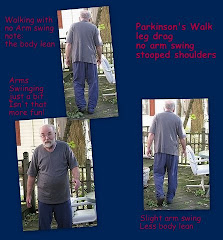
7. Swing your arms Yes, both of them. Lots of good reasons. Practice by sitting in an armless chair and just swing. Now get out of that chair and stride across the room while you swing both arms. It will loosen the muscles, aid your balance, generally make you feel better by lessening fatigue. If you are already having difficulty moving one arm, get your arms moving before you begin to walk. It may sound odd but when you first try to walk and swing your arms, you will find it is easier if your arms are already in motion.

Reach higher

Warm up: Stretch your arms as high as you can before you begin the weight carry. Feel the stretch in your arms, neck, chin, shoulders, spine, stomach, small of your back and gluteal muscles. The better the stretch, the more you will feel it throughout your body. Don't overstretch, this is a warm up.
For finer finger tasks

9. Daily tasks are becoming difficult. If you are having problems buttoning your shirts you can buy an entirely new wardrobe and go western with snaps or you can retrain your fingers to button the shirts in your closet. Put on a shirt and button and unbutton 5 times the first day, 10 times the next, 15 times for the next session and finally 20 times. You will find that it becomes easier with repetition. You will have to bring this exercise back into your regimen many times as your PD progresses. My wife made me do this 20 times the first day but I think that easing into it would be better.

Perhaps it is buckling your seat belt. Practice 10 to 20 times every time you are in the vehicle. You have to consciously relearn that which may be hidden in your brain.

10. Yawn. Oh good grief! Just keep yawning that big, rude fake yawn until your body picks it up naturally yawns. But why yawn? One theory is to induce more oxygen into the body and to expel carbon dioxide. Paratroopers often yawn before jumping and Olympic athletes are known to yawn before competition.
Yawning opens the shoulders, that is it relieves some muscle tension by the very act of yawning. It may stretch the lung tissues and increase the heart rate. It also frees the diaphragm. And here is where it is really important, it is a step towards clearer speech. By opening the throat it helps you avoid choking by eliminating swallowing problems.  And don't just yawn, pandiculate. Get your arms and shoulders involved in the stretching that comes with a real yawn. You see it on TV. Arms out at the shoulders, hand to the mouth.  Throw out your chest and stretch back from the shoulder blades. Feel your throat opening.

Don't yawn alone. If possible get someone to yawn along with you. It is contagious so beginning with a fake yawn will usually result in real and productive yawns.

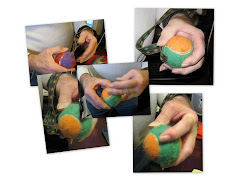
For a simple hand stretching exercise, try the tennis ball between the fingers. 
Thumb and indexfinger
Roll to index and middle fingers
Then roll to middle and ring finger
The ring and pinkie are the hardest
Although you feel as if you should be squeezing the ball, stretching is better for PD