Precursor Symptoms of PD - What's the Tipoff? And What Were Your Earliest PD Symptoms?
In retrospect; in hindsight; if only I'd known; I wish I'd looked for more answers; why didn't the doctor say something? I should have...done something more...
If the precursor symptoms are recognized as Parkinson's disease, can early intervention at least delay the onset?
Earliest warning symptoms of Parkinson's usually go ignored or are attributed to some other condition. There isn't a single symptom you or your loved one can have that is unique to PD, although as a group some are more unique. There are diagnostics which can rule out some many differential diagnoses even at this early date.
The biggest impediment to addressing the developing Parkinson's disease after the early warning signs or precursor symptoms appear is that we do not recognize them for what they are. We don't even know what they are.
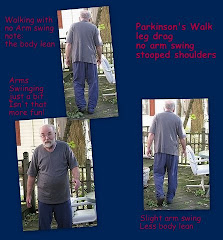
- Leg drag
- Lack of Arm Swing
- Loss of Sense of Smell - decreased sense of smell - phantom smells
- Changes in Handwriting
- Changes in Voice
- Change in Facial Expression
- Pain or achiness in the Shoulder or Neck, more common in women
- Depression, anxiety, stress
- Sleep problems - especially with especially with REM sleep or more specifically RBD sleep. Sleep issues may also include "acting out" during sleep: Yelling, kicking, punching.
- Signs of specific Vitamin Deficiencies: Ds and Bs especially
- Sharp small pains - pinprick pains - or perhaps small areas of numbness
- An odd type of vertigo - which may actually be Orthostatic Hypotension which is known to develop years before the actual PD diagnosis
- Dizziness
- Adding additional symptoms beginning 4-05-11 with THANKS to the folks at Patients Like Me
- Urinary issues such as urinary incontinence or frequency
- Impairment of color discrimination - may improve with levodopa
- Fatigue - tiring more easily at routine tasks - lack of stamina - daytime sleepiness
- Cramping
- Rhinorrhea - that's a runny nose to most of us
- Seborrhoeic dermatitis - an autononic symptom, an immunodeficiency - flaking is often confused with dry skin - possibly seen as dandruff
- numbness - usually in extremities
- We would like to learn if people experienced any of the following as precursor - earliest - symptoms
- Sleep apnea ?
- Constipation
- RLS - restless leg syndrome?
- Excessive sweating - an autonomic nervous system dysfunction?
- Personality changes or changes in Executive functioning
- Hyperhydrosis or excessive sweating which can sometimes appear as Seborrhoeic dermatitis - might feel like hot flashes
- Erectile Dysfunction
- Vision issues such as difficulty focusingI'd also like to add: Unexplained tripping or falling which I overlooked
In an era when there is access to symptoms of every conceivable disease at our fingertips, there is little information about PD precursor symptoms on the Internet. If you do a web search, you won't find much about them. I just did that and mostly what I found were articles I'd already written.
Think back to the months and even years before your diagnosis, what do you recall of the precursor symptoms? We're talking about those symptoms which you attributed to being tired, to stress or anxiety, to physical exertion, to anything but PD because that wasn't even a consideration.
So you are X-rayed, MRI'd, you have endocrine tests, thyroid tests, blood tests and a few more for good measure and that's good because it makes sense with these early symptoms. But PD doesn't show up on these kinds of tests currently. And then what happens?
The doctor rules out a condition or two and then gives you the verdict: "Well, you don't have X*X?." And that's it. You pay your bill, you go home, your spouse asks what the doctor said and you say, "Well I don't have X*X?." Many of us have been trained to accept this kind of negative diagnosis, but that's wrong. We can all do better.
As families and patients we have a right to expect some positive action. And doctors should certainly know this. That message needs to be sent from the patient base if it isn't taught in medical schools. As patients we have a responsibility too. We have to overcome the relief that we don't have X*X? and the fear of what comes next and we have to ask, "What comes next?"
The very early warning signs are now being recognized as an significant area of study but the symptom list is not ready for prime time yet. The communication from the research front will be forthcoming when the studies have been completed. The good news is that studies are now underway.
These studies represent a way in which people with PD can contribute. Even if we can't improve the future for ourselves, we can use what we have learned to improve the precious future of someone else, perhaps our children or grandchildren.
Listed at Clinical Trials.gov are three studies of especial interest:
- Investigate neurophysiologic tests that have the potential of serving as screening tools- New Haven, CT
- Consortium On Risk for Early-onset Parkinson's Disease (CORE PD) It is still recruiting at Columbia University, NY, NY and at Rush University Medical Center, Chicago, IL
- Developing hindsight: Biomarkers of Risk of Parkinson Disease
Another source of information is found in the notes in patient files tucked away in doctors' offices. This is the information that needs to be shared at seminars, in articles. There would be no HIPAA violation, names would not be named but the symptoms could be compiled. Yes, it is a huge undertaking but it would make a remarkably useful study.
Our best body of knowledge now comes from proactive patients who share their stories. Not all are sucess stories but they demonstrate the importance of a the current studies and the importance of a productive doctor-patient relationship. Many thanks to those enerous folks on Patients Like Me who added to the list of early warning symptoms.
It is far more important for both the medical profession and the general public to raise their awareness of early warning symptoms of neurodegenerative diseases, especially Parkinson’s disease, because treatment can begin earlier. Now that there are more treatment and therapy options, it makes sense to try to slow onset.
What we are wondering is whether the immediate treatments will lie more in Alternative Medicine in the form of Nutritional Supplements rather than in pharmacological medications. What will be the role of therapies such as Forced Exercise?
What we are wondering is whether the immediate treatments will lie more in Alternative Medicine in the form of Nutritional Supplements rather than in pharmacological medications. What will be the role of therapies such as Forced Exercise?
Previous posts on subject:
Questions about Parkinson's Disease
You might also be willing to contribute to the knowledge base by registering to participate in an NIH study:
You might also be willing to contribute to the knowledge base by registering to participate in an NIH study:
Study Link for Biomarkers of Risk of Parkinson's Disease at the National Institutes of Health.
Check our this discussion of the Top Ten non-motor symptoms of Parkinson's disease from Dopadoc.


 Posts
Posts