Showing posts with label cognition. Show all posts

Monday, November 14, 2011

Anxiety and Parkinson's Disease

We Don't Know Why but Anxiety Is a PD symptom
Frankly, at this time, I'm not so concerned with the why but rather the effect of anxiety on Steve's Parkinson's disease progression.  While anxiety is not unexpected when one receives a diagnosis, from what I've read, it is a more common symptom in PD than in say Diabetes, Rheumatoid Arthritis and Multiple Sclerosis. As a matter of fact it is a PD precursor symptom, often accompanied by pessimism. I always thought that Steve was over-thinking things and expressing them in a negative way; now I realize that this was a PD potential rearing its head when he was still a young man.

What we do know is that embarrassment is a risk factor for anxiety and social fears. We know that there might be an association with levodopa although probably not the other PD meds.  We know that there may be an association with norepinephrine (dopamine is the norepinephrine precursor so you can't have one without the other) and we know that there are several other neural pathways which might contribute. We've got our eye on Serotonin and GABA.  

Here's the thing, we know that anxiety was behind Steve's first bout of dehydration even though the underlying issue was actually Benign Prostatic Hyperplasia (BPH) or enlarged prostate. This in turn exacerbated feelings of urinary incontinence which in its own turn triggered extreme  anxiety - enough to stop all fluid intake except for a morning cup of coffee and enough water to swallow pills and supplements. We focused on the dehydration, how to rehydrate and how to get him back on his feet to think and to function on his own again.  We treated the cause and he started taking a common (and risky) prostate medication which he had turned down a several years earlier when he and his doctor discussed his prostate issue and actually checked for and ruled out prostate cancer.  But we never looked at the other issue - the anxiety which overrode all else.

The treatments for PD anxiety at this time are problematic.  Antidepressants of various classes: Tricyclics, SSRIs, Anti-psychotics, Benzodiazepines, and non-selective MAOIs.  In early 2010 we just weren't ready to risk the motor symptom treatment for the anxiety/non-motor symptom.

So what happened in the late summer and early fall with the second round of dehydration?  The second time around was easier to spot and know what to do. I was prepared already with electrolyte beverages - mostly fruit flavored. We kept the drinks flowing. He prefers ice water from the pitcher.  We had the adult incontinence briefs on hand to relieve the issue of weakened ability to get to the bathroom on time and to get through the night. Although there was no question of doing the right things for recovery, each time there seems to be a larger cognitive deficit.

We recently made some other nutritional supplement changes and I adjusted up and down to determine if they constituted any part of the problem. All the time, the vivid dreams, the hallucinations and illusions increased making Steve's reality very confusing; contributing to the a high anxiety level.

We finally resorted to using an herbal to help with the anxiety after I realized that he was self-medicating with aspirin and found an empty bottle - which had been almost full a week before. I read everything I could find about the herbal components because it does help relieve the anxiety on a short term basis. The best I can say is that it seems to have the fewest contraindicated ingredients.  Certainly a better option now than prescription medications. 

In addition to retreating to the safety of his bedroom for frequent naps - mostly because he feels anxious, one significant new issue was freezing. We are still working through this problem. Steve now has his key words to help him through the tight spots but it took 3 months and he intermittently lets panic rule so that he mixes up the words in the commands:  Look Up and Walk Forward. Mostly they had a calming effect and then anxiety takes over and the words become other words - the wrong commands.  

I can now see that fear in his shuffle step. It makes me wonder how many shufflers out there are just plain scared.  I hadn't seen it in those movements for many months but now I recognize the enemy. It isn't just postural instability - a precursor or early symptom of his - it is his terror that something bad will happen on the next step.

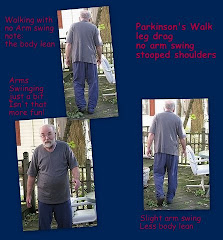
I know he has recovered just enough arm swing with the new form of buffered creatine monohydrate that he can walk at a slow pace but with a normal balanced stride, shifting his weight from side to side, using his shoulders to propel himself forward (that's Walk Forward)  He has to be reminded in the early morning, when he wakes from a nap and in the evening but sometimes he can let himself relax enough to walk without anxiety. That makes my heart sing.

Watch those stairs
Our next project will be stairs.  He's gone downstairs only a few times since the dehydration but he had few problems going down and none on the way back up.  But he is afraid. He sees a black hole and not the steps leading to the 1st floor. He is anxious every time he walks past the stairway. His sister, a nurse, mentioned that perhaps it is eyesight issues which help trigger the fear and we'll check that possibility. 

We're looking for solutions to the anxiety, the cognition losses, and the PD psychosis which play a large part in making his world a more frightening place. One possible solution may lie in a clinical trial taking place in our neck of the woods.  We provided a link to the Fox Trial Finder in the right column under Clinical Trials but how serendipitous to have a reminder email from PAN (Parkinson's Action Network) this morning. I used that link, and looked at trials in our area again and found some new ones.  So we sent an email to the Pimavanserin Trial, heard back promptly with a phone number and are waiting to hear back from the Cleveland Clinic Study Coordinator. We are hoping that if the psychosis can be treated, we can work more effectively to lessen the anxiety.

Addendum 3/12:
On 3/06/12 The Parkinson's Disease Foundation presented an Expert Briefing, A Closer Look at Anxiety and Depression in Parkinson's Disease led by Dr Laura Marsh. The archived webinar/podcast is now available at PDF.  Listen rapidly as Dr Marsh covered a lot of material in a short period of time. I plan to listen again.

Friday, August 5, 2011

The Effects of Added Stress in Parkinson's Disease

Does Stress Exacerbate PD Symptoms?
Dehydration Brought on by Stress

Things have been a bit hectic around here for the last several weeks. Hectic means that Steve will be become stressed no matter how things are handled.  And stress means that there is little predictability about how he will react. Here it meant that Steve was growing steadily more anxious about the impending appearance of the roofing crew. Strangers were going to be all over his roof doing work which he could no longer supervise let alone climb the ladders to monitor. To top it off family dogs were spending their parents' vacation with us.

Having a father-daughter chat
The Corgis didn't come to Ohio this summer to brighten the days with their grins and antics but our daughter was able to spend some quality time with Steve. After Lois left for Georgia, the English Setters arrived while their mom and dad traveled to New England to repair plumbing and visit aging AD parents .

For me the roofing job was stressful in terms of $$$$$ spent and the not-so-hot clean-up which followed but it was a relief to have the roof leak-free. It should outlast us. For Steve it was the stress of unknown people, sun-up to sunset noise, and chaos that sent him around the corner to a darker place.

We know that stress means that the PD patient will become more symptomatic. Tremors appear more frequently. If Steve is severely stressed, his entire body might shake. As soon as he calms down, that shaking will stop as abruptly as it began. But it is the psychological symptoms which really affect his physical state. When feeling stressed, one symptom is that he manifests is feeling that he has to urinate more often - not unusual - but in the case of many men, it means that he is going to lower his fluid intake to avoid accidents. His body also becomes more rigid and he walks with a tiny shuffle severely impacting his balance.

In this hot summer with fans but no central air conditioning, the sweat level has also been high. And that feeling of heat fatigue is not conducive to drinking more water to compensate but rather to begin the shut down.  Dehydration looks a lot like the end stages of Parkinson's.

Although I caught the dehydration symptoms early and tried to monitor the water consumption, he pulled a water bottle bait and switch on me and it was a few days before I realized that he was showing me the older empty bottles. And then...the bottom fell out.

Let's face it, caregivers are often pushed to their limits by their charges. Whether you are a spouse, sibling or child, there comes a time when the fear and the urgency of the situation (feels as if it) forces us from gentle into harpy mode. He complains that he is dying and you find yourself in the body of a screaming bitch who is yelling, Do you want to live? Then stop trying to kill yourself. Help me help you!  There is no question that the fear-factor forced him to give this some thought by the next morning and he was more open to suggestion but still quite demanding..

Even though Steve never cared about really cold drinks, ice water has helped more than anything else. It isn't a lot of ice water at one time but rather, smaller amounts frequently...we topped off everything with a few sips through the straw. (Yes, I know he doesn't like straws but they are helping)  I mixed his creatine (which must be first dissolved in very warm water) with ice cold blueberry/pomegranate juice. And he now downs it promptly. We use 2 or 3 trays of ice cubes a day just on his ice water. Too much water can also be damaging to the system - more is not always better just as less is always not more.

Instead of going through weeks and weeks of a debilitating condition as he did in the winter of 2009-2010, he is coming back steadily from that horrible place. He can walk down the hall without help; although the cane is useful with four dogs around. He can get into bed on his own again. Am I going to let him select his medications and supplements from the organizer?  Not for awhile yet - perhaps not again.

Eventually we will report on adult underwear and other incontinence aids we have used. Some are clearly more absorbent than others. For now, the fever is gone, the total confusion is ending, he is neither helpless nor totally rigid in the morning, unable to get out of bed. Yes, he needs encouragement to gently stretch before sitting up. At least now he can do that.

He has been miserable as he saw everything seem to vanish over night. Cognition, movement, bladder control, ability to dress, to function. He couldn't even use the TV remote a few days ago; now he's back to switching programs I am listening to in midstream.  He walks down the hall easily pushing aside the rawhide dog chews and gently tapping with his care to ask a resting canine to move clear of his path.  He has even become more careful with his special PD prisim lenses because he is back online and can't see the monitor without these glasses.

Topper watching roofers
Willson sleeps comfortably
Despite Steve's fussing, I firmly believe having the Setters visit was a help for both of us, not to mention Harry and Rita. The silky Setters make for delightful and calming petting in the temporary absence of the cats.  While Blakey comes upstairs to complain from time to time, he has chosen to spend most of his time in the much cooler dehumidified basement with Mongo who does not like any dogs but his own.
 
Next year we may add a dehumidifier for the 2nd floor. And next week I'll lay in a better supply of drinks to compensate for electrolyte loss.  We're going to add cocomut water and Gatorade to the pantry.

Friday, October 1, 2010

Glutamate, The Caffeine Gene, and the World Parkinson's Congress

What are we learning about glutamate and Parkinson's disease?

There's good news

For years we've been asking restaurants to omit the MSG because we get funky headaches later after eating foods containing this excitotoxin. We'v been reading food labels to avoid monosodium glutamate.  We were already working on an article about glutamate and the role this protein building amino acid and neurotransmitter plays in Parkinson's disease. We learned a little about the good, the bad and the ugly in the process. 

We know that glutamate is a rapid, excitatory transmitter and that it can be associated to a vulnerability to addiction, so perhaps you could call it the smoker's nemesis.  We also know that glutamate receptors are necessary for proper central nervous system functioning, for important cognitive function including memory formation and learning.

This week everyone is talking about glutamate and GRIN2A because of the news from the World Parkinson's Congress currently being held in Glasgow, Scotland.

The coffee cups are waiting 
It has been learned that GRIN2A, is the "coffee" gene which when combined with caffeine intake appears not only to be neuroprotective for PD in a certain percentage of the population but may also affect PD clinical trial results when some study participants may have the altered GRIN2A gene.  This in turn raises the question of whether it can also influence medications used to treat Parkinson's disease symptoms.

Those people protected by the caffeine gene are carriers of a specific variation of GRIN2A according to information discussed at the World Parkinson's Congress.  At this time the focus is on a limited population.

We already know from the long Hawaii coffee study that people who had regular caffeine intake were (48%-84%) less likely to develop Parkinson's disease. It would be more than interesting to know how many members of this study also had the special GRIN2A gene version. But that was then and we didn't have the same technology or gene bank.

GRIN2A is a glutamate NMDA subunit receptor in a class of ionotropic glutamate gated ion channels, permeable to calcium. There has already been research about Bipolar disorder, ADHD and Huntington's disease as well as Parkinson's disease in connection to a hypoglutaminergic condition being involved in the pathogenesis.  And certainly the negative role of glutamate in Parkinson's development is not unknown.

Researchers have been looking at the GRINB2 subunits for many years and their connection to PD in the forms of selective antagonists which can exacerbate levodopa-induced dyskinesia in animal models. In other animal studies it was discovered that loss of striatal dopamine led to an increased stimulation of NR2B aka GRIN2B which contains NMDA receptors.

Basically glutamate becomes a link in the nitric oxide chain.  Under certain conditions glutamate can break through the outer cell membrane via the NMDA (n-methyl-d-asparatate) receptors located on the neurons.  This creates a breach through which calcium can enter the cell.  We already know that calcium is implicated in the death of dopamine neurons. If this chain can be interrupted...

To read more about the 2010 World Parkinson's Congress and to see folksy photos, check out Talk Parkinson's
Additional reading:
Gene reference: GRIN2A 

Wednesday, June 9, 2010

Changing Stages of Parkinson's Disease

I'm Back

This is the first  article I have written for my blog in almost six months.  After eight years of  having Parkinson's disease and treating it fairly successfully with medication, alternative medication and nutritional supplements, exercise, massage and diet changes, I ran into trouble between Thanksgiving and Xmas last year.  I thought they were symptoms of  PD.

The urinary symptoms which had been under control were no longer controllable; perhaps because I was neglecting to take the herbals which had helped for so long. Suddenly I had to urinate really frequently and didn't always make it to the bathroom even though my bed is only 20 feet away. I became afraid to leave home for fear of being too far from a rest room. Vivid dreams occurred so often that I could not tell what was real and what was not. My overall memory of this period is vague but I felt as if I were dying.

Although I primarily stayed in bed, often I thought I was someplace else and worried about how I was going to get home. In an amazingly short period of time I went from the early stages of Parkinson's to an advanced state; it seemed to take 2 or 3 weeks. (Editor's comment: it was practically overnight)

How did I get to that state?

In early November I had an appointment with my primary care doctor to discuss some alternative treatment options.  He referred me to the neurologist to continue this discussion. The urinary issues were not discussed although we did discuss my arthritic knee and the loose tendons. One area of concern for me was the MRI he proposed.  I do not like MRIs. I do not like being in places which I cannot leave of my own free will. 

Even the open MRI which I was supposed to have done years ago, did not take place because it was too stressful for me. This doctor  suggested that we could begin with an Xray and take it from there.  He gave me the lab order but I was too shaken by the mere mention of an MRI to do even that.

We made the neurology appointment as suggested and then my wife decided that the Xrays had to be done before that appointment in three weeks.  She finally nagged me to the lab for the Xrays a few days before I was to see the neuro.  That weekend I hardly slept and the urinary issues were getting worse. I wasn't eating as much and had been limiting my coffee and tea intake because of the urinary frequency and urinary hesitancy. As a matter of fact, I was limiting all fluid intake.  No fluid - no urinary frequency - no problem. But there was a problem and the frequency urges did not stop.

By the time we were talking to the neurologist, the transition was taking place. I asked not for the intended alternative treatment but for Sinemet which I thought would help the urinary issues.  He agreed after the routine PD testing.  By the next day the nightmare was developing full force.

Almost overnight I was having difficulty walking down the hall. I could barely stand erect. Cognitive skills were muddled by hallucinations and illusions.  I needed assistance to get into bed, instructions just to roll over. I needed help pulling up the blanket. Dressing and bathing without help was impossible. I would get up to eat but continued to drink only enough liquid to swallow a pill.  I recognized the woman who prodded me about drinking more water during the day as being very similar in appearance to the woman who responded to my nightly hollering for help. Who was she?  This nurse gave me my wife's name when I asked.  What was this place?

My wife, meanwhile, was learning what you need to do to get a doctor's secretary to relay the seriousness of a condition. Because I had signed a release allowing the office to speak to my wife about my care, she knew she was on safe ground there. Her early calls were partially successful.  The primary care office called back to refer her to the neurologist. The neurologist called back to say that Parkinson's disease can't go through such a short term transition and so we were looking for another cause possibly a UTI...and referred her back to the primary care doc.

She made the appointment for the following Monday and sat down to think and to discuss the issue with the massage therapist when she called to cancel my appointment. Sleep deprivation was only part of the problem.  So she gave me cranberry capsules insisting that I drink more water.  For half a day, I had a return to normalcy.  And she had an insight.  I was dehydrated

When we went to the doctor's appointment, she took my urine specimen along.  She insisted that it be tested.  When it came back negative the discussion turned to prostate issues.  We left with sample bottles of Flomax.  What we didn't know was how long it would take before the Flomax would work - that it actually would be another 5 weeks before for the compulsive insistence that she walk me to the bathroom every 20 minutes would stop.

The dehydration issue was caused by the enlarged prostate which I knew about but didn't discuss much. Years earlier I didn't want to take the meds and had found relief with herbals. But this time I had confused the prostate problem with PD which exhibits the same symptoms.  I'm an older man, older men frequently develop prostate issues.  Had I talked to my new doctor about the problems instead of accepting that they were part of the disease, I wouldn't have had to endure all of this.  The damage done by the dehydration, the stress for all of us except the cats - the dogs were very subdued during the first month - was intense.

It has been a long recovery and we learned a few lessons and revisited a few others.

 1)  Protective underwear is cheap in comparison to losing 4 productive months.
 2)  Sign that doctor's release now so that your spouse or other family member can talk to the doctors office
 3)  Don't make that call or visit the doctor without a complete written list - make copies
 4)  Symptoms of dehydration and sleep deprivation are similar to dementia and to PDD
 5)  Ask how long it will be before you can expect to feel results from a medication
 6)  If a nutritional supplement helps, don't stop taking it just because there are so many pills to take
 7)  Don't assume that the problem is caused by the Big Problem;there can also be other medical issues - tell your doctor. 
 8)  Just because a doctor prescribes it, that doesn't mean you shouldn't do your own research for contraindications. (I have a faxed-in prescription that we will never fill for just that reason - my wife did the homework)
 9)  All of you caregivers out there deserve more credit than you receive! 
10) Be persistent - it can be depressing - don't give up.