PD Items of Interest Worth Repeating
Don't look now - and I mean that literally - but it is official, the FDA (US Food and Drug Administration) has approved the Neupro Rotigotine Transdermal Patch (again) It is estimated that the Neupro patch will be back in pharmacies by July of 2012 - then you can look.
For those who would like to relish the moment, you can read the press release from Neupro headquarters in Brussels, Belgium as it was published earlier today, 4/03/2012.
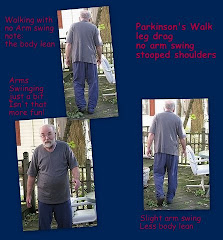
For those who have been curious about the pharmaceutical grade micronized creatine monohydrate and the NETPD project to evaluate neuroprotective ability, I have little to report as I have not heard from the NETPD project coordinators in response to two simple questions. For those interested in the Steve's motor improvement on 10mg daily, partial arm swing returned to his left arm - the right one has been fine all along.
The CREST-E Huntington's disease study professionals generously included the information that the test subjects would receive 40mg daily. So after we increased Steve's daily amount to 20mg I noticed him walking down the hall with both arms swinging, shoulder's fully engaged. An email acquaintance who has neurdegeneration but not PD reported an improvement in his speech after taking micronized creatine monohydrate. That's really exciting.
And yes, we will be reducing the daily creatine dosage and even taking a couple of off-days every month for renal and liver protection. And yes, we are increasing his fluid intake with water, juice and electrolyte drinks.
Have you visited Mary Spremuli's website for PD and stroke Speech Therapy, breathing aids and DVD classes. Don't forget to SHOP while there. I can't think of a better present for someone with swallowing, breathing and speech issues and one of her classes on DVD. They are especially great for folks who don't get out.
Things we are trying: Coconut Oil, for the medium chain triglyceride (MCT) benefits. This time we're shooting for moving from 2.5 tablespoons (or 7 tsps) to 3.5 tbsp a day but it isn't easy. We're supplementing with capsules but that is really expensive. You can also buy MCT oil to combine with coconut oil. Don't eliminate the Omega 3 fish oil, coconut oil doesn't contain those essential fatty acids.
I didn't know that another use of Amantadine is to reduce the side effects of dopamine agonists such as Mirapex and Requip. I wish we'd known this when Steve and his Neuro removed the Amatadine from his early regimen because that was when the hallucinations and impulse control problems began. It is also used later to help relieve dyskinesia, a wearing-off side effect when there is excessive cell death.
Another thing I'd like to mention in passing is that when taking levodopa as Mucuna Pruriens, it is possible to overdose because there is little equivalency information. I can tell you that we have ordered EGCg and green tea capsules for Steve to take with the Mucuna Pruriens rather that the Curcuminoids (MAO-A and B inhibitors. Just a test with nothing to report yet.
I got a real eye opened at the recent Parkinson's Disease Foundation Expert Briefing: A Closer Look at Anxiety and Depression in Parkinson's Disease by Laura Marsh, MD of the Michael E DeBakey VA Medical Center and Baylor College of Medicine, Houston, TX. It is now archived at PDF for your listening and slide viewing.
We'd had to stop the medical massage back in 2010 when Steve became dehydrated because of the BPH and the PD incontinence issues. It was a mistake not to pick it up again once he became healthier. So we're trying to find a more convenient location despite the excellence of his previous therapist. Massage is also behavioral therapy which might help get him back on track or at least pointed at the tracks.
The National Parkinson Foundation (NPF) launched the first-ever nationwide initiative called Aware in Care which features a free kit. The kit includes the tools to make hospital stays for patients with PD safer. According to NPF, "emerging data shows that poor hosiptal care for people with PD is on the rise - very often resulting in serious complications that are completely preventable."
When you go to ORDER you will be pleasantly surprised some of the forms simply by clicking More Information under a manual and can then download it in pdf format. They are also available in Spanish. Although there is no charge for the kit, you are welcome to make a donation.
Also from the National Parkinson Foundation is their announcement of a Yoga Retreat for people with Parkinson's and Caregivers. You can read more about the 4-day Spring or Fall programs at the Kripalu Center in Stockbridge, Maryland in the eBrochure.
We received an email from Mike Justak, a YOPDer who is undertaking the task of putting together a video presentation called Faces of Parkinson's Video Wall. as a Parkinson's Awarness project. If I can ever figure out how to upload videos - videos used to be Steve's territory - he and his companion, Blakey the black cat, will be there too.
Showing posts with label Creatine-PD. Show all posts
Tuesday, April 3, 2012
Tuesday, August 25, 2009
Will Creatine Slow Parkinson's Disease Progression?
Having the energy to prevent PD cell death
Parkinson's patients have been taking creatine for years. It is a
protein produced by the liver combining the amino acids, arginine, glycine and methionine to store cellular energy. Some forms of creatine produce creatine phosphate which is an energy source for nerve cells. The theory is that the energy created will help prevent mitochondrial loss - cell death - which is characteristic of Parkinson's Disease, ALS, Huntington's and muscular dystrophies.
Creatine is not a one dose fits all nor is it without side effects. Some of the side effects include dehydration, cramps, nausea, gas, diarrhea, renal stress and lowered blood pressure. Often lowered blood pressure will produce dizziness.
In 2000 an NIH sponsored trial of Creatine and the antibiotic, Minocycline, for ALS showed promise and suggested that further study was needed for Parkinson's. In that 12 month study patients received 200 mgs of minocycline and 10 mgs of creatine daily or a placebo. The minocycline was not well tolerated. The trial indicated the need for a study larger than 200 participants.
In March 2007 the National Institute of Health (NIH) - NINDS announced sponsorship of a phase III clinical trial to see if Creatine can slow the progression of PD. The trial is huge and will be enrolling 1720 people at 51 medical centers in North America. The trial is currently enrolling.
The first of a series of clinical trials from laboratory research to clinical trials under the heading of NIH Exploratory Trials in Parkinson's Disease (NET-PD), this trial will run between five to seven years. It is being led by Dr Karl Kieburtz of the University of Rochester and Barbara C Tiley, PhD of the Medical University of South Carolina in Charleston.
Body builders have been taking creatine for years to improve
exercise performance and build muscle. There have been studies which imply that creatine can improve mitochondria function and may function as an antioxidant to reduce oxidative stress. In PD lab mice creatine has already been demonstrated to prevent loss of specific cells.
In the past I've taken different forms of creatine but have only noticed that I feel somewhat dizzy. I'm considering taking it again but in combination with at least CoQ10.
In this trial progression will be measured using the standard rating scales of quality of life, ability to walk, cognitive function and the ability to carry out other activities of daily living.
Who will be eligible: people diagnosed with PD within the last 2 to 5 years AND are being treated with levadopa or other medications which increase dopamine levels in the brain. Only half of the patients will receive creatine in this double blind study. The trial is using 5 mgs daily of creatine supplied by Avicena Group, Inc
People interested in participating in this study can obtain more information by calling 1-800-352-9424, emailing or visiting the clinical trial site at NIH. You can check for a nearby location at the NIH website.
Next we will look at creatine in combination with other additives including CoQ10.
references:
Press Release
The Minocycline-Creatine trial
Parkinson's patients have been taking creatine for years. It is a
Creatine is not a one dose fits all nor is it without side effects. Some of the side effects include dehydration, cramps, nausea, gas, diarrhea, renal stress and lowered blood pressure. Often lowered blood pressure will produce dizziness.
In 2000 an NIH sponsored trial of Creatine and the antibiotic, Minocycline, for ALS showed promise and suggested that further study was needed for Parkinson's. In that 12 month study patients received 200 mgs of minocycline and 10 mgs of creatine daily or a placebo. The minocycline was not well tolerated. The trial indicated the need for a study larger than 200 participants.
In March 2007 the National Institute of Health (NIH) - NINDS announced sponsorship of a phase III clinical trial to see if Creatine can slow the progression of PD. The trial is huge and will be enrolling 1720 people at 51 medical centers in North America. The trial is currently enrolling.
The first of a series of clinical trials from laboratory research to clinical trials under the heading of NIH Exploratory Trials in Parkinson's Disease (NET-PD), this trial will run between five to seven years. It is being led by Dr Karl Kieburtz of the University of Rochester and Barbara C Tiley, PhD of the Medical University of South Carolina in Charleston.
Body builders have been taking creatine for years to improve
In the past I've taken different forms of creatine but have only noticed that I feel somewhat dizzy. I'm considering taking it again but in combination with at least CoQ10.
In this trial progression will be measured using the standard rating scales of quality of life, ability to walk, cognitive function and the ability to carry out other activities of daily living.
Who will be eligible: people diagnosed with PD within the last 2 to 5 years AND are being treated with levadopa or other medications which increase dopamine levels in the brain. Only half of the patients will receive creatine in this double blind study. The trial is using 5 mgs daily of creatine supplied by Avicena Group, Inc
People interested in participating in this study can obtain more information by calling 1-800-352-9424, emailing or visiting the clinical trial site at NIH. You can check for a nearby location at the NIH website.
Next we will look at creatine in combination with other additives including CoQ10.
references:
Press Release
The Minocycline-Creatine trial
Subscribe to:
Posts (Atom)