I have switched to a new health plan as of the first of the year and I'm in the process of getting new doctors. I'd been hoping that I could find doctors from University Hospital which my Kaiser plan didn't allow but the Aetna plan does.
Ten days ago I had my first appointment with a University Hospital internist. As a Parkinson's patient it can be difficult to change doctors. Is he/she going to be traditional (sinemet) or alternative (CoQ10). This is my life and I want my doctor to see me and not a disease. I need to be proactive the the medical decisions made about my life.
On the phone, I had let the receptionist know that we were looking for a doctor with an open mind to possibilities. She advised me that while the doctor was not a Parkinson's specialist, he sounded like the person I needed.
As she suggested, I requested my medical records immediately so that I could carry them with me to the appointment although I should probably have dropped them off a day early.
She also advised me that Kaiser could take a while getting the records ready. The form actually had spaces for "pickup" and my phone number except the RUSH, added by a kindly intake woman at Kaiser. Days went by and no one called as we were told, instead Kaiser sent a letter telling me what I owed for the records. I received that letter on the day we drove over to pay for and pickup the package.
When I went to the appointment I was hoping not to hear any of the wrong words but I was prepared to keep on shopping if I needed too. We had made a list.
He began the appointment by greeting me and saying, "I understand meeting a new doctor can be stressful". That put me at ease as he looked through my medical records and asked me questions about what he saw.
My biggest concern was that I would not be able to find a doctor who would okay my prescription for DyaCirc which I am taking off label for my Parkinson's. That turned out to be no problem as he understood it could be used for PD.
He gave me the name of a movement disorder specialist (MDS) at the medical school with whom to make additional appointments, since I had never seen one under my Kaiser health plan. While I had seen a neurologist, she was not a movement disorder specialist. He also sent me to a dermatologist for head lesions that I've had for several years and so far always biopsy as benign.
He also encouraged me to see if switching from DynaCirc to its generic, Isradipine, would work for me. If isradipine helps me and I can tolerate it, the savings will be close to $1,800 a year.
One other good sign: I had printed out the information I had about Dynacirc CR and when I presented it, he asked if he could keep those copies for review with his students.
My impression of him: warm and friendly, easy to talk to. And willing to learn new things. He's going to be my doctor!
Showing posts with label Neurologist. Show all posts
Showing posts with label Neurologist. Show all posts
Wednesday, January 28, 2009


Thursday, November 6, 2008
PARKINSON'S DISEASE IS NO DAY TRIP
The Journey of Parkinsons disease
In their clinical review The Journey Mary G Baker and Lizzie Graham use the analogy of the diagnosis of a disease such as Parkinson's, a chronic neurological illness, as a journey. People want to know their itinerary, what to expect so that they know how to pack. And therein lies the first problem.
According to Baker and Graham many patients find that the initial diagnosis is given in such a way that they have no idea what to do to prepare for the journey. Parkinson's is no day trip. Most PD patients find that they have to be so proactive in their treatment that they become the travel agent and not their physicians.
Yes, "physicians" is correct; not just one doctor but two or more. In the UK, NICE, the National Institute for Health and Clinical Excellence, has determined that a GP cannot give the diagnosis but must refer the patient to a specialist immediately for further evaluation. Eventually there will be blood tests or genetic tests to provide accurate diagnoses and prevent misdiagnoses. Since there is no direct access, for now diagnosis remains subjective usually through a PDRS.
There may be many professionals you will need to visit during this journey: neurologist, general practitioner, pharmacist, podiatrist, ophthalmologist, optometrist, physical and/or occupational therapists including massage and swim therapists. You may also talk to dietitians, psychologists, sex therapists, otolaryngologists or speech and hearing therapists, social workers, nurses, gerontologists.
PD is not a disease journey to travel alone if possible. Patients and their families, the caregivers have many questions. Doctors need to be able to provide those answers and to provide some direction. Baker and Graham suggest that the best way is to ask the patient what they want to know but to be prepared in case the patient is still shocked and confused by the diagnosis.
The immediate questions will be: Will I die? Can I work? How do I tell my family? Is there a cure? How will this disease affect my relationships? Will I need someone to take care of me? How does the disease progress? What medication therapies are available? Is there any surgery? Is there alternative therapy? Can I receive physical therapy or occupational therapy? What do I do now?
The first priority for your doctor is honesty. Patients need to know that treatable does not mean curable but that treatment can forestall the onset of some symptoms and make the journey far less unpleasant. After all, this is not a trip anyone chooses to make.
Patients don't need the extra-baggage euphemism that PD won't kill you. If that were reality, people and guns don't kill, it would be the bullets and the bleeding that kill you. Death rows would be virtually empty. Patients need straight talk and doctors need to have the answers or know where to find them.
A good travel agent will know that not every traveler will enjoy the same itinerary just because this journey is Parkinson's. A good doctor will understand that some patients may respond better to different routes of treatment and be prepared. A good traveler won't accept the rack rate and good patients will know that they have to voice their opinions, to ask questions and certainly to request treatment options.
In their clinical review The Journey Mary G Baker and Lizzie Graham use the analogy of the diagnosis of a disease such as Parkinson's, a chronic neurological illness, as a journey. People want to know their itinerary, what to expect so that they know how to pack. And therein lies the first problem.
According to Baker and Graham many patients find that the initial diagnosis is given in such a way that they have no idea what to do to prepare for the journey. Parkinson's is no day trip. Most PD patients find that they have to be so proactive in their treatment that they become the travel agent and not their physicians.
Yes, "physicians" is correct; not just one doctor but two or more. In the UK, NICE, the National Institute for Health and Clinical Excellence, has determined that a GP cannot give the diagnosis but must refer the patient to a specialist immediately for further evaluation. Eventually there will be blood tests or genetic tests to provide accurate diagnoses and prevent misdiagnoses. Since there is no direct access, for now diagnosis remains subjective usually through a PDRS.
There may be many professionals you will need to visit during this journey: neurologist, general practitioner, pharmacist, podiatrist, ophthalmologist, optometrist, physical and/or occupational therapists including massage and swim therapists. You may also talk to dietitians, psychologists, sex therapists, otolaryngologists or speech and hearing therapists, social workers, nurses, gerontologists.
PD is not a disease journey to travel alone if possible. Patients and their families, the caregivers have many questions. Doctors need to be able to provide those answers and to provide some direction. Baker and Graham suggest that the best way is to ask the patient what they want to know but to be prepared in case the patient is still shocked and confused by the diagnosis.
The immediate questions will be: Will I die? Can I work? How do I tell my family? Is there a cure? How will this disease affect my relationships? Will I need someone to take care of me? How does the disease progress? What medication therapies are available? Is there any surgery? Is there alternative therapy? Can I receive physical therapy or occupational therapy? What do I do now?
The first priority for your doctor is honesty. Patients need to know that treatable does not mean curable but that treatment can forestall the onset of some symptoms and make the journey far less unpleasant. After all, this is not a trip anyone chooses to make.
Patients don't need the extra-baggage euphemism that PD won't kill you. If that were reality, people and guns don't kill, it would be the bullets and the bleeding that kill you. Death rows would be virtually empty. Patients need straight talk and doctors need to have the answers or know where to find them.
A good travel agent will know that not every traveler will enjoy the same itinerary just because this journey is Parkinson's. A good doctor will understand that some patients may respond better to different routes of treatment and be prepared. A good traveler won't accept the rack rate and good patients will know that they have to voice their opinions, to ask questions and certainly to request treatment options.
It is important that the patient converse with someone who is not only knowledgeable about the journey but who can also be available for reasonable periods of time to help guide this trip. This is true in both the planning stage but for reassessments while in transit.
Concept Source: The Journey of Parkinson's disease by Mary G Baker and Lizzie Graham, BMJ 2004;329;611-614
Thursday, October 16, 2008
Swim Therapy for Parkinson's Symptom Relief
8:00am is kind of early for me now since my Home Depot days of the 2:30am alarm clock. Nevertheless I was awake and walking through a light rain in the parking lot of the Peter B. Lewis Aquatic & Therapy Center headed for the front door. It was my first appointment there.
Inside the building the front desk personnel looked at my insurance cards, gave me a long medical questionnaire to fill out, a HIPPA briefing and an arm full of handouts. My therapist, Ron came out. He introduced himself and we walked back to an exam room where we reviewed my medical history.
I was impressed by Ron's knowledge of Parkinson's and his thorough reading of my medical record. He was really concerned that I wasn't using a chair when I take a shower. He told me that a lot of people only find out they have a balance problem when they fall in the tub and break an arm or fracture their skulls. He reminded me that falls are the number two cause of death of Parkinson's patients.
Next, I stripped to my briefs and Ron checked my strength and range of motion at a number of joints of my body. He recorded all this information in a laptop. Then he gave me a neurological exam that was as good as any neurologist has given me.
Inside the building the front desk personnel looked at my insurance cards, gave me a long medical questionnaire to fill out, a HIPPA briefing and an arm full of handouts. My therapist, Ron came out. He introduced himself and we walked back to an exam room where we reviewed my medical history.
I was impressed by Ron's knowledge of Parkinson's and his thorough reading of my medical record. He was really concerned that I wasn't using a chair when I take a shower. He told me that a lot of people only find out they have a balance problem when they fall in the tub and break an arm or fracture their skulls. He reminded me that falls are the number two cause of death of Parkinson's patients.
Next, I stripped to my briefs and Ron checked my strength and range of motion at a number of joints of my body. He recorded all this information in a laptop. Then he gave me a neurological exam that was as good as any neurologist has given me.
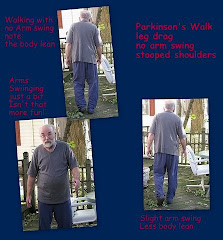
Finally he watched me walk and made some suggestions about how I could learn to take longer strides to eliminate the shuffle I have been developing. He pointed out that I was taking two striding steps but dragging my left foot on the third step. He said I would have to be aware of that drag which indicated the shortening of the stride so that I could step away from that drag to a normal pace.
Back at the desk Ron told me that he would design an exercise program for me. It would reduce my symptoms and allow me to do more physically. He gave me a twice weekly schedule for the next four weeks, told me to get some aquatic shoes, bring my swim suit and next week he'd start teaching me the exercises.
I'll keep you posted.
Subscribe to:
Posts (Atom)


 Posts