Showing posts with label tremors. Show all posts

Friday, August 5, 2011

The Effects of Added Stress in Parkinson's Disease

Does Stress Exacerbate PD Symptoms?
Dehydration Brought on by Stress

Things have been a bit hectic around here for the last several weeks. Hectic means that Steve will be become stressed no matter how things are handled.  And stress means that there is little predictability about how he will react. Here it meant that Steve was growing steadily more anxious about the impending appearance of the roofing crew. Strangers were going to be all over his roof doing work which he could no longer supervise let alone climb the ladders to monitor. To top it off family dogs were spending their parents' vacation with us.

Having a father-daughter chat
The Corgis didn't come to Ohio this summer to brighten the days with their grins and antics but our daughter was able to spend some quality time with Steve. After Lois left for Georgia, the English Setters arrived while their mom and dad traveled to New England to repair plumbing and visit aging AD parents .

For me the roofing job was stressful in terms of $$$$$ spent and the not-so-hot clean-up which followed but it was a relief to have the roof leak-free. It should outlast us. For Steve it was the stress of unknown people, sun-up to sunset noise, and chaos that sent him around the corner to a darker place.

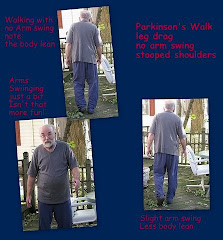
We know that stress means that the PD patient will become more symptomatic. Tremors appear more frequently. If Steve is severely stressed, his entire body might shake. As soon as he calms down, that shaking will stop as abruptly as it began. But it is the psychological symptoms which really affect his physical state. When feeling stressed, one symptom is that he manifests is feeling that he has to urinate more often - not unusual - but in the case of many men, it means that he is going to lower his fluid intake to avoid accidents. His body also becomes more rigid and he walks with a tiny shuffle severely impacting his balance.

In this hot summer with fans but no central air conditioning, the sweat level has also been high. And that feeling of heat fatigue is not conducive to drinking more water to compensate but rather to begin the shut down.  Dehydration looks a lot like the end stages of Parkinson's.

Although I caught the dehydration symptoms early and tried to monitor the water consumption, he pulled a water bottle bait and switch on me and it was a few days before I realized that he was showing me the older empty bottles. And then...the bottom fell out.

Let's face it, caregivers are often pushed to their limits by their charges. Whether you are a spouse, sibling or child, there comes a time when the fear and the urgency of the situation (feels as if it) forces us from gentle into harpy mode. He complains that he is dying and you find yourself in the body of a screaming bitch who is yelling, Do you want to live? Then stop trying to kill yourself. Help me help you!  There is no question that the fear-factor forced him to give this some thought by the next morning and he was more open to suggestion but still quite demanding..

Even though Steve never cared about really cold drinks, ice water has helped more than anything else. It isn't a lot of ice water at one time but rather, smaller amounts frequently...we topped off everything with a few sips through the straw. (Yes, I know he doesn't like straws but they are helping)  I mixed his creatine (which must be first dissolved in very warm water) with ice cold blueberry/pomegranate juice. And he now downs it promptly. We use 2 or 3 trays of ice cubes a day just on his ice water. Too much water can also be damaging to the system - more is not always better just as less is always not more.

Instead of going through weeks and weeks of a debilitating condition as he did in the winter of 2009-2010, he is coming back steadily from that horrible place. He can walk down the hall without help; although the cane is useful with four dogs around. He can get into bed on his own again. Am I going to let him select his medications and supplements from the organizer?  Not for awhile yet - perhaps not again.

Eventually we will report on adult underwear and other incontinence aids we have used. Some are clearly more absorbent than others. For now, the fever is gone, the total confusion is ending, he is neither helpless nor totally rigid in the morning, unable to get out of bed. Yes, he needs encouragement to gently stretch before sitting up. At least now he can do that.

He has been miserable as he saw everything seem to vanish over night. Cognition, movement, bladder control, ability to dress, to function. He couldn't even use the TV remote a few days ago; now he's back to switching programs I am listening to in midstream.  He walks down the hall easily pushing aside the rawhide dog chews and gently tapping with his care to ask a resting canine to move clear of his path.  He has even become more careful with his special PD prisim lenses because he is back online and can't see the monitor without these glasses.

Topper watching roofers
Willson sleeps comfortably
Despite Steve's fussing, I firmly believe having the Setters visit was a help for both of us, not to mention Harry and Rita. The silky Setters make for delightful and calming petting in the temporary absence of the cats.  While Blakey comes upstairs to complain from time to time, he has chosen to spend most of his time in the much cooler dehumidified basement with Mongo who does not like any dogs but his own.
 
Next year we may add a dehumidifier for the 2nd floor. And next week I'll lay in a better supply of drinks to compensate for electrolyte loss.  We're going to add cocomut water and Gatorade to the pantry.

Monday, March 29, 2010

Differential Diagnoses and Parkinson's Disease

What do the stereotypes mean for you and PD?

We already know that the precursor symptoms of Parkinson's disease can show their presence years before the disease is full blown and diagnosable.  We always want to be reassuring or to be reassured when we notice them. So we tell each other and ourselves:

"Oh, it's nothing"
"You're just stressed"
"Well who wouldn't have sleeping problems, you're depressed"
"Losing your sense of smell is convenient, now you can avoid changing the cat box"
"Perhaps that neck and shoulder pain is from the way you sit at the computer"
"Get another pair of shoes, you're dragging your leg when you walk"
"Get a new pen, your handwriting has changed"
"That tingling is the beginning of carpal tunnel, get a wrist rest"
"Try these pills to help you sleep or for your depression"
"Who wouldn't be depressed, you're not sleeping enough"

And so a few years pass and the next symptoms appear and you make that dreaded appointment.  Afraid to know but afraid to delay treatment.

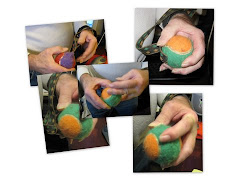
When that tremor appears, people know it is time. The good news for many is that that an action or a postural tremor is not PD. Sometimes it is a sign of Essential Tremor, which isn't curable but in many cases more manageable.  And you can drink to that.  But that postural tremor which occurs not when the limb is at rest but rather when performing an action can also be a sign of renal or liver failure, of hyperthyroidism, of Dystonia; it can be caused by medications, hypoglycemia or Fragile X Syndrome(FXTAS). The list is long and the diagnosis needs a professional so that the proper treatment can be initiated.

Then there are the people diagnosed with Parkinson's Disease who actually have Parkinson's Plus: the Multiple System Atrophy group (MSA), Progressive Supra-nuclear Palsy (PSP), Dementia with Lewy Bodies (DLB) and Corticobasal Ganglionic Degeneration (CBGD).  There is even Parkinson's with ALS The correct diagnosis is necessary to avoid delaying the correct treatment to improve quality of life.

Let's face it, for many people it may seem to be less frightening if they can arm themselves with information before their doctor's appointment. Reading about conditions can actually help you prepare a more thorough list of symptoms. Other people only want to know more after the diagnosis. Before getting any on-line prompts and suggestions, it's a good idea to make that list of all  your symptoms and when they occur. That way you won't be as easily swayed by suggestion.
 .
Although there is not always good news, there are helpful online sites for many conditions.  The Parkinson's sites are listed in the right hand column here as Helpful Links.  For Parkinson's Plus one of the most informative sites is actually eMedicine from WebMD.  The National Institute of Neurological Disorders and Stroke (NINDS) provides a brief but helpful overview of tremor. So does Medline Plus.  You can read about Essential Tremor at several sites.  In our opinion the best site for Essential Tremor information is WeMove.org.  Another site with a helpful chart of pathology of the nervous system is Wikipedia.

The point is that if you are prepared for your doctor's appointment by having a symptom journal, you can be not only proactive in providing some of the information needed to make the most accurate diagnosis but you can also become a significant part of your medical team.  And yes, you are going to need you.

We know of patients who have been told to go home to die. While having your financial affairs in the best order possible and by spending quality time with family and friends is excellent advice for everyone, we just heard a patient's take on that give-up advice from a very courageous woman. When told that there was nothing she could do for her MSA, she asked the doctor if he would give his wife, daughter, mother or sister that same advice. He saw her point and treatment became interactive. We think she's doing very well in finding a course of alternative treatment. She said she had no choice, she wanted to live and there was no hope by following the doctor's advice.    

Even if those early warning signs don't send you to the doctor, at least make a mental or written note.  If the symptom persists, pay attention, your body is telling you something that could be important.